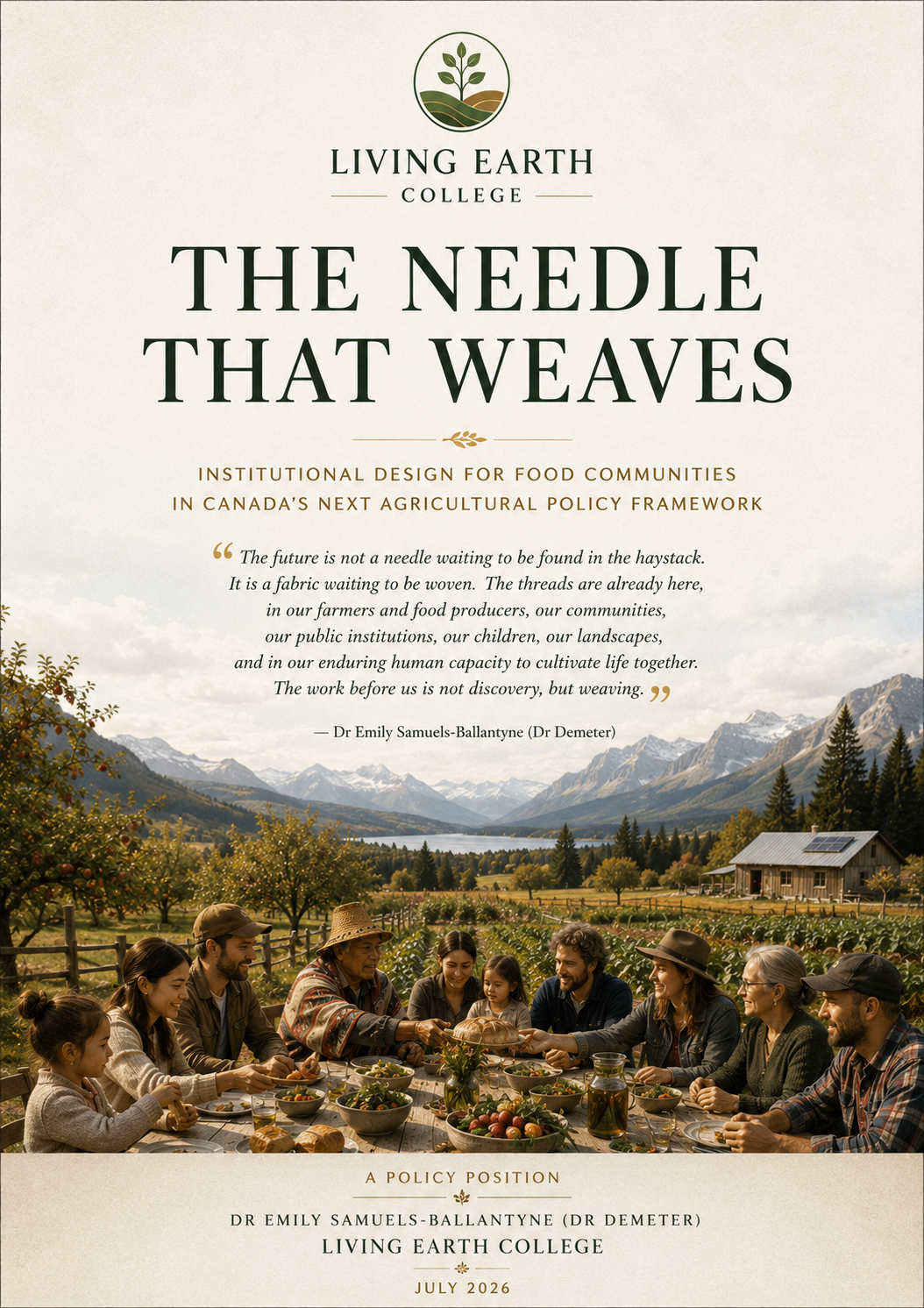
The Needle That Weaves
A Con Viv Policy Position for Agriculture and Food Systems
The Needle That Weaves presents the Con Viv policy position for agriculture and food systems. Developed through more than two decades of research and practice across Australia, Canada and Europe, it offers a living systems approach to institutional design that complements existing agricultural policy by strengthening the relationships between governments, farmers, Indigenous communities, educators, municipalities, civil society and citizens.
Rather than viewing governance primarily as the administration of programs or the regulation of activity, Con Viv proposes that the enduring role of public institutions is to cultivate the conditions in which people and places can flourish together. In an era of climate uncertainty, food insecurity, biodiversity loss and growing social fragmentation, resilient food systems depend not only on technical innovation, but on the capability of communities to collaborate, learn, adapt and steward the living systems upon which agriculture depends.
The metaphor of the needle captures this role. A needle does not create the thread; it weaves existing threads into a stronger and more resilient fabric. Likewise, effective public policy strengthens the connections that already exist across the food system rather than creating parallel structures that fragment effort.
At the heart of this policy position are Seven Needles for Public Policy—a practical framework for designing institutions that move beyond compliance towards capability, participation and stewardship. These principles support governments in creating policies that enable local innovation while strengthening food security, ecological resilience, rural vitality and civic participation.
Con Viv is intended as a practical contribution to the future of Canadian agriculture: one that recognises food systems as living systems and positions governance as the work of weaving together the capacities that already exist within communities, landscapes and institutions.
This policy position is offered as an invitation to collaborate in designing the next generation of agricultural policy—one that works with living systems to build resilient communities, healthy ecosystems and a thriving food future.