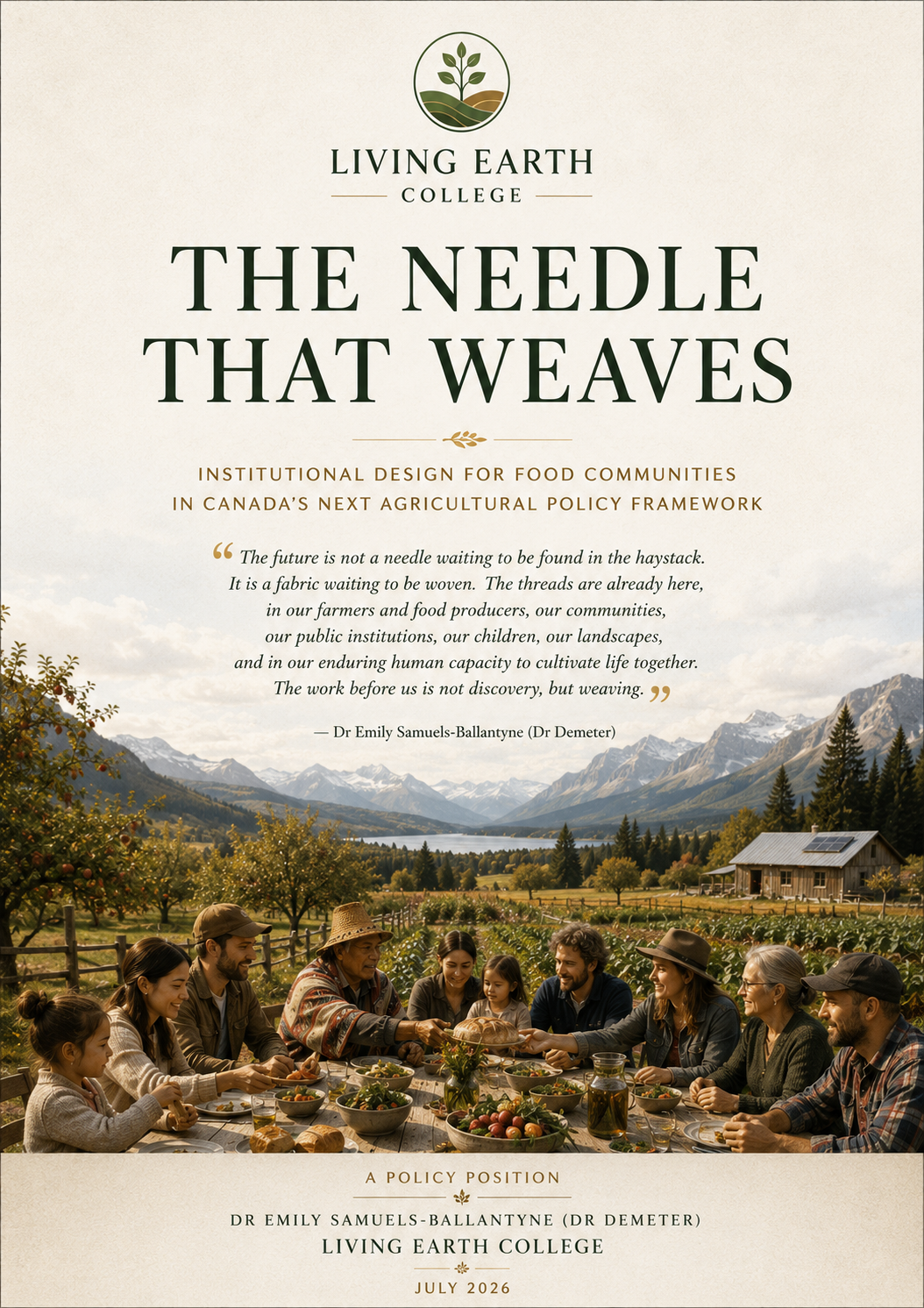
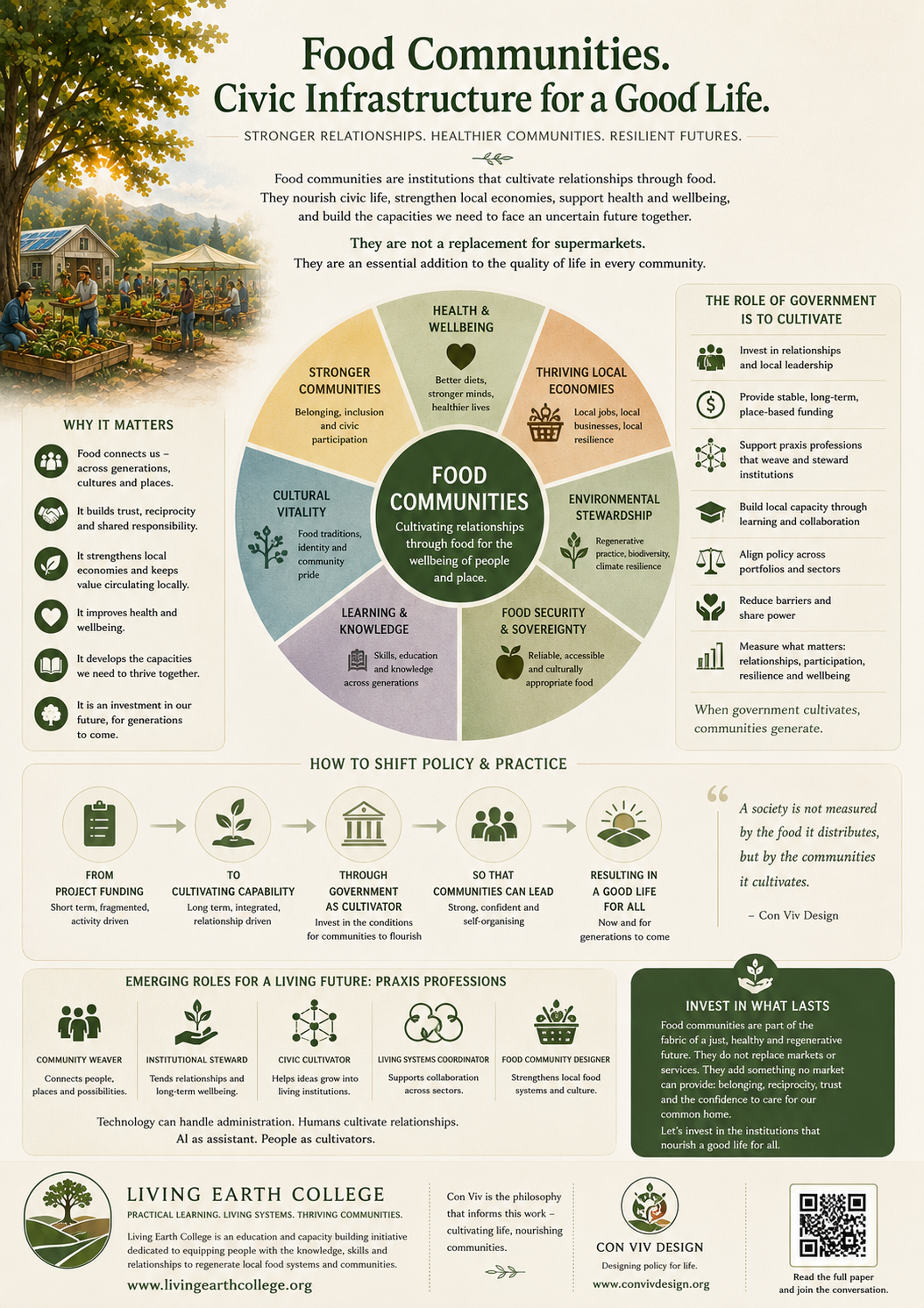
Policy Position: The Needle That Weaves: Institutional Design for Food Communities in Canada's Next Agricultural Policy Framework
Submitted to: Agriculture and Agri-Food CanadaNext Agricultural Policy Framework Consultation
Prepared by Dr Emily Samuels-Ballantyne (Dr Demeter) Living Earth College & Con Viv Design July 2026
"The future is not a needle waiting to be found in the haystack. It is a fabric waiting to be woven. The threads are already here, in our farmers and food producers, our communities, our public institutions, our children, our landscapes, and in our enduring human capacity to cultivate life together. The work before us is not discovery, but weaving."
— Dr Demeter
Freedom, Participation and the Purpose of Food Communities
At the heart of this paper lies a simple proposition: the future of Canada's food system should not be determined by compulsion but by freedom. Con Viv does not propose that every citizen should grow their own food, shop exclusively at farmers' markets, or abandon supermarkets. Nor does it suggest that governments should prescribe what percentage of food every community ought to produce locally. Such targets may be appropriate in some places and unrealistic in others, particularly across a country as geographically, culturally and ecologically diverse as Canada.
Instead, Con Viv begins with a different understanding of freedom. Freedom is not simply the freedom to choose between products on a supermarket shelf. It is the freedom to participate meaningfully in the systems that sustain life. It is the freedom to know the people who grow our food, to share meals with neighbours, to contribute to a community garden if we wish, to support local farmers when we are able, to learn from Indigenous knowledge holders and experienced growers, to teach our children where nourishment comes from, and to participate in the shared work of cultivating healthy communities. Equally, it is the freedom not to participate in every aspect of community food life. A living society honours diversity in the ways people contribute according to their interests, capacities and circumstances.
Food communities therefore do not replace the existing food system. They enrich it. Supermarkets will continue to play an essential role within Canada's food system, particularly given the country's vast geography and the complexity of contemporary food distribution. Farmers will continue to supply regional, national and international markets. Restaurants, processors, distributors and retailers will all remain important participants within a healthy food economy. The contribution of food communities is different.
Their purpose is not primarily to produce a particular percentage of food, but to cultivate a particular quality of relationship. They provide the civic spaces through which people may encounter one another around the shared work of nourishment, rebuilding the habits of trust, reciprocity and cooperation that every resilient society requires. They reconnect citizens with landscapes, farmers with communities, schools with local knowledge, healthcare with nourishment, municipalities with place, and generations with one another. In this sense, food communities become places where culture is continually renewed.
Culture is not created through policy documents or public campaigns alone. It is created through repeated acts of participation that gradually become shared customs, expectations and ways of living together. A weekly community meal, a seasonal harvest celebration, children learning alongside Elders in a school garden, neighbours organising a cooperative food purchase, or families volunteering during a local harvest may appear to be small acts in themselves, yet together they weave the relationships from which civic life is formed.
This is why food communities matter, because they strengthen the social fabric not because everyone participates in the same way, but because everyone has the opportunity to participate according to their own freedom, interests and gifts. Some may grow food. Others may cook, teach, organise, transport, preserve, mentor, celebrate, invest or simply gather around the table. Every contribution has value because every contribution strengthens the relationships upon which resilient communities depend.
The measure of a successful food community is therefore not simply the volume of food it produces or the percentage of local food consumed. Those measures remain important, but they are not sufficient. The deeper measure is whether people know one another better than they did before, whether trust has increased, whether children experience food as a living relationship rather than merely a commodity, whether farmers are recognised as partners in community life, and whether citizens have greater opportunities to participate in shaping the food systems upon which they depend. Con Viv understands this as the civic purpose of food.
Food nourishes bodies, but it also nourishes relationships. It creates opportunities for freedom to be expressed through participation, for culture to be renewed through shared practice, and for the social fabric to be woven, patiently and continuously, one relationship at a time. In this way, food communities do not ask citizens to withdraw from modern society. They invite them to participate more deeply in it, strengthening the living relationships that allow both communities and democracy to flourish.
Praxis Professions: Cultivating the Living Institutions of Society
If Food Communities are to become enduring civic institutions rather than a succession of short-term projects, then they require more than funding. They require people whose professional responsibility is the ongoing cultivation of relationships, institutional capability and community participation. This represents not simply the creation of new jobs, but the emergence of a new class of professional practice.
For much of the twentieth century, governments quite appropriately invested in professions designed to administer industrial society. Public servants became programme managers, policy officers, grant administrators, compliance specialists and service coordinators, ensuring that increasingly complex systems functioned efficiently and responsibly. These roles remain essential, yet the challenges now confronting society are no longer simply administrative. Climate change, food insecurity, declining civic participation, social isolation and ecological degradation are fundamentally relational challenges that cannot be solved through administration alone.
Con Viv proposes that alongside traditional professions there is now a need for Praxis Professions: people whose primary work is the cultivation of living systems. Their responsibility is not simply to deliver programmes, but to strengthen the relationships from which resilient communities emerge. They connect farmers with schools, municipalities with community organisations, health with food, citizens with place and policy with everyday practice. They cultivate trust, support collaboration, steward institutional memory and help communities develop the confidence and capability to organise themselves around shared purpose.
The emergence of artificial intelligence makes this shift increasingly possible. As routine administrative tasks, reporting, scheduling, compliance and data management become more efficiently supported through digital technologies, human attention can increasingly return to the work that cannot be automated: listening, mentoring, convening, facilitating, mediating, observing patterns, resolving conflict, growing and nurturing relationships. Rather than replacing people, technology has the potential to release people into more deeply human work.
This represents a new understanding of governance. Governments do not simply fund activities; they cultivate capability. They invest not only in projects, but in the people whose daily practice is the patient weaving of relationships that allow communities to flourish over generations. In this way, Praxis Professions become an essential component of civic infrastructure, ensuring that Food Communities are not sustained by goodwill alone, but by skilled practitioners dedicated to cultivating the living institutions upon which resilient societies depend.
Part I – The Needle That Weaves
There is an old expression that speaks of searching for a needle in a haystack. It is a metaphor that has become so familiar within public life that we rarely stop to question what it assumes about the nature of change. Faced with increasingly complex social, environmental and economic challenges, we have become accustomed to believing that somewhere, hidden amongst thousands of possibilities, there exists the one innovation, the one technology, the one programme, the one investment, or the one brilliant idea that will finally transform the system. Governments search for it through new policy initiatives. Researchers pursue it through evidence and experimentation. Philanthropic organisations invest in it through pilot projects. Communities themselves continually seek new ways of responding to challenges that appear to grow more intricate with every passing year. We have become remarkably proficient at searching for needles.
Yet perhaps the difficulty is not that the needle has been difficult to find. Perhaps the difficulty lies in forgetting what the needle is for. A needle does not exist simply to be discovered. Its purpose has always been to weave. It joins what has become separated, strengthens what has become fragile, repairs what has been torn, and patiently creates fabric from individual threads that, by themselves, possess neither the strength nor the beauty that emerges when they are brought into relationship with one another. The wisdom of the needle lies not in its rarity but in its capacity to connect. This simple shift in metaphor has profound implications for the future of agricultural policy.
For more than twenty years I have worked alongside farmers, community organisations, educators, local governments, universities and nonprofit organisations across Australia, Europe and, more recently, Canada. During this time I have witnessed extraordinary generosity, remarkable ingenuity and an enduring commitment to building healthier relationships between people, food and place. I have seen communities establish farmers' markets where none previously existed, develop community-supported agriculture programmes, create neighbourhood gardens, organise food hubs, coordinate volunteers, establish seed libraries, experiment with cooperative purchasing, introduce school food initiatives and design countless other ways of reconnecting people with the sources of their nourishment. Every one of these initiatives represents an act of hope. Every one deserves recognition for the care, imagination and persistence required to bring it into being.
What has remained with me, however, is not simply the diversity of these initiatives but the remarkable consistency of the challenges they encounter. Although the landscapes differ, the cultures differ and the institutional settings differ, remarkably similar patterns continue to emerge. Transportation becomes difficult, storage is inadequate, regulations designed for large-scale industrial systems prove cumbersome for community initiatives. Volunteer energy becomes exhausted and funding is fragmented into short cycles that reward innovation while rarely supporting continuity. Farmers struggle to coordinate with consumers, consumers struggle to coordinate with one another, and community organisations often find themselves attempting to solve problems that extend far beyond their own capacity or mandate.
For many years these appeared to me as practical problems requiring practical solutions. Like many others working within community food systems, I found myself asking how transport might be improved, how logistics could become more efficient, how collaboration might be strengthened, or how governments might provide additional support. These questions remain important, yet over time another question began to emerge, one that gradually reshaped my understanding of the work itself. What if these recurring difficulties were not simply operational problems? What if they were revealing something much deeper about the institutions within which our food systems are expected to function?
The more closely I observed, the more difficult it became to ignore a striking paradox. Across all three continents there was no shortage of commitment. Farmers wanted stronger relationships with their communities. Citizens wanted healthier and more affordable local food. Municipalities were increasingly recognising the importance of food security. Educational institutions were exploring food literacy. Health professionals were beginning to understand food as preventative medicine. Governments were investing significant resources in innovation and regional development. The individual threads were already present.
Yet the fabric remained fragile. The prevailing response has often been to create another project. Another grant. Another demonstration site. Another pilot programme. Another innovative partnership. Each contributes something valuable and each offers opportunities for learning, but together they reveal an assumption that has quietly shaped contemporary public policy. We continue to believe that transformation will emerge through the accumulation of successful projects.
Projects, however, are not the same as institutions. Projects are born, funded, evaluated and completed. They depend upon enthusiasm, exceptional leadership and temporary investment. Institutions are different. They provide continuity. They cultivate memory. They create shared expectations about how communities organise themselves and care for one another across generations. Schools, libraries, public health services and volunteer fire brigades endure not because they are continually reinvented but because society has recognised them as essential expressions of civic life. We do not ask each generation to prove that schools should exist. We have already accepted that education is a public good deserving of long-term stewardship.
Perhaps the time has come to ask whether food communities deserve similar recognition? This question does not diminish the importance of markets, entrepreneurship or agricultural production. Rather, it invites us to recognise that food occupies a unique place within society. Food is never merely a commodity. It is simultaneously ecological, economic, cultural, educational, social and deeply personal. Every meal carries within it relationships between soil, water, climate, farmers, transport systems, markets, families, neighbourhoods and communities. Food is one of the few places where the entire ecology of civic life becomes visible within our everyday experience.
When we understand food in this way, the purpose of agricultural policy also begins to change. Rather than asking how governments might simply support agricultural production or stimulate local markets, we may instead ask how public policy can cultivate the conditions through which citizens, communities, farmers, Indigenous knowledge holders, educators, local governments, health organisations and civil society are enabled to weave enduring relationships around the shared work of nourishment. The task is no longer one of managing individual programmes but of strengthening the institutional ecology that allows communities themselves to flourish.
This understanding has gradually emerged through my research and practice as what I have come to call Con Viv. Although it first became visible through food systems, Con Viv is not fundamentally a theory about food. Food has simply been the living laboratory through which a broader understanding has revealed itself. Con Viv is a framework for institutional design within living systems. It begins with the recognition that the capacities required for renewal already exist within our communities. They do not need to be invented, imported or imposed from above. They already reside within farmers, neighbours, schools, community organisations, municipalities and citizens themselves. The challenge is not to create these capacities, but to cultivate the institutional conditions through which they may recognise one another, enter into relationship and become capable of weaving resilient forms of civic life.
This, I believe, is the opportunity before Canada's Next Agricultural Policy Framework. It is an opportunity to move beyond the understandable desire to search continually for another needle in the haystack and instead to recover a more fundamental insight. The future of our food systems will not be secured through isolated projects alone, however innovative they may be. It will be secured through the patient work of weaving relationships into institutions, institutions into communities, and communities into the enduring fabric of civic life. The needle has always known its purpose. Perhaps the time has come for public policy to remember it as well.
Part II
Listening to Food Systems
One of the privileges of working across different countries is that, after a time, it becomes increasingly difficult to explain away recurring patterns as local anomalies. Every landscape possesses its own history, every community carries its own culture, and every nation develops institutions shaped by its particular political and economic circumstances. Australia is not Canada. Canada is not Europe. The climatic conditions differ, the scales of production differ, the regulatory frameworks differ, and the histories through which agriculture has evolved are distinct. Yet beneath these visible differences there exists a remarkable consistency that only becomes apparent through sustained observation. Communities separated by thousands of kilometres frequently ask the same questions, encounter the same obstacles and, perhaps most significantly, begin to imagine remarkably similar responses. We are in the aftermath of an industrialised food system.
My own understanding of this pattern did not emerge through comparative research alone. It emerged gradually through practice. It was formed while standing beside farmers discussing the uncertainty of another growing season; while listening to municipal officers attempting to reconcile planning regulations with community aspirations; while working alongside volunteers who gave generously of their time to establish gardens, food hubs and educational programmes; while participating in conversations with educators, health practitioners and local leaders who all recognised that food occupied a central place within community wellbeing, yet often found themselves constrained by institutions that divided responsibility into separate departments, funding streams and professional disciplines.
In Tasmania, where much of my work has been grounded, I became increasingly aware of a paradox that has shaped many food-producing regions throughout the world. Here was a landscape capable of producing extraordinary quantities of food, celebrated internationally for its agricultural products and natural environment, yet many local communities struggled to access affordable, locally produced food through the ordinary rhythms of everyday life. Farmers frequently expressed frustration that they could not receive fair prices while consumers simultaneously experienced increasing food costs. Public health initiatives encouraged healthier eating while many families found highly processed foods more economically accessible than fresh produce. Environmental programmes promoted biodiversity, yet agricultural policy often remained primarily concerned with production efficiency and export markets. None of these observations suggested failure. Rather, they revealed a system in which each institution was working diligently within its own mandate while the relationships between those institutions remained comparatively weak.
Europe offered another perspective. Conversations with practitioners, researchers and educators revealed societies with long traditions of civic organisation, local markets and cooperative structures, yet these communities were confronting many of the same questions concerning resilience, food sovereignty, ageing farming populations and the future of rural life. It became increasingly apparent that technical knowledge alone was insufficient to address these challenges. Communities were searching for new forms of participation capable of reconnecting citizens with one another as much as reconnecting consumers with producers. Questions of governance, education, cultural identity and democratic participation continually surfaced alongside discussions of agriculture. Food functioned not simply as an economic sector but as a meeting place where broader questions concerning the future of society quietly emerged.
More recently, my work in British Columbia brought these patterns into particularly sharp focus. Working alongside community organisations committed to strengthening regional food systems, I encountered remarkable energy directed towards practical experimentation. Mobile produce markets, warehouse sales, direct purchasing from farmers, educational initiatives, volunteer programmes and collaborative partnerships all sought to answer a deceptively simple question: how might local food become more affordable, more accessible and more deeply embedded within community life? What impressed me most was not merely the creativity of these initiatives but the willingness of communities to learn through action. Rather than waiting for perfect solutions, they experimented, reflected, adapted and tried again.
Yet it was here that another insight became unmistakable. Regardless of how imaginative these initiatives became, they repeatedly encountered barriers that no individual organisation could resolve alone. Transport infrastructure, food safety regulations, procurement systems, insurance requirements, labour shortages, fragmented funding and institutional complexity continually reappeared. These were not failures of leadership, nor deficiencies of commitment. They were signals that communities were reaching the limits of what voluntary initiative alone can accomplish within institutional arrangements that had evolved for very different purposes.
It was during this period that I began to realise that I had spent twenty years listening not simply to farmers or communities, but to food systems themselves.
Living systems speak differently from institutions. They rarely announce themselves through policy documents or organisational charts. Instead, they reveal their character through recurring patterns. They express themselves through relationships, through feedback, through resilience, through vulnerability and through the quiet persistence of communities who continue to organise around shared needs despite the obstacles they encounter. To listen carefully to a living system is to notice not only where problems arise but where life continually seeks to reorganise itself in response to changing conditions.
Again and again I observed communities attempting to weave new relationships between citizens, farmers, schools, local governments, health organisations, Indigenous knowledge holders and civil society. They were not waiting for permission to care for one another. The impulse already existed. Indeed, it seemed to arise quite naturally wherever people gathered around the shared work of nourishment. What remained uncertain was whether our public institutions recognised these emerging relationships as peripheral experiments or as the early expressions of a new civic architecture.
This distinction is of profound importance. If we continue to regard community food initiatives merely as projects, they will continue to compete for temporary funding, rely upon extraordinary volunteers and remain vulnerable to changes in political priorities. If, however, we begin to recognise them as institutions in formation, our responsibility changes. The question becomes not how to manage them more efficiently, but how to cultivate the conditions through which they may mature into enduring expressions of civic life.
It is this lesson, gathered slowly across Australia, Europe and Canada, that has shaped the argument of this paper. The recurring patterns are too consistent to dismiss as coincidence. They suggest that the future of resilient food systems will depend not primarily upon discovering new technical solutions, but upon recognising and strengthening the institutional relationships that communities are already beginning to weave for themselves.
Part III
From Projects to Participation
One of the enduring characteristics of contemporary public policy is its remarkable capacity to initiate projects. Across agriculture, health, education, regional development and community wellbeing, governments have become increasingly adept at creating programmes designed to stimulate innovation, encourage collaboration and address complex social challenges through targeted investment. Calls for proposals are released, partnerships are formed, pilot initiatives are funded, outcomes are measured, reports are written and, in many cases, valuable learning takes place. There is much within this approach that deserves appreciation. Indeed, many of the most creative responses to food insecurity, ecological degradation and rural decline have emerged because governments were willing to invest in experimentation and because communities were willing to respond with imagination and commitment.
Yet over time a question has quietly begun to emerge that extends beyond the success or failure of any individual programme. What happens when the pilot concludes? What becomes of the relationships that have been cultivated, the knowledge that has been generated, the trust that has been established and the capacities that communities have painstakingly developed once the project itself reaches its conclusion? Why do so many promising initiatives appear to flourish briefly before gradually diminishing, not because they lacked value, but because the institutional conditions required for their continuation were never fully established?
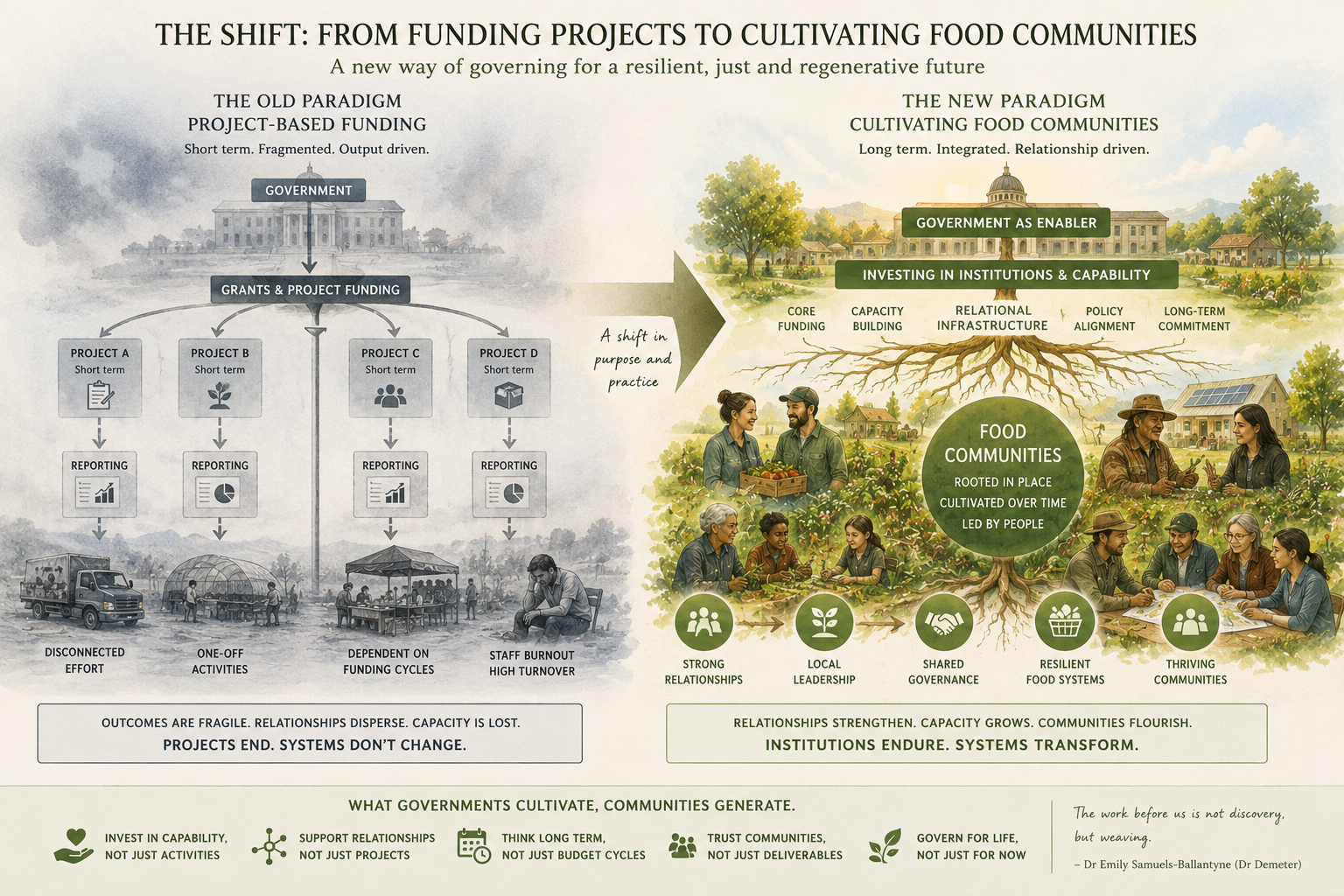
These questions are not criticisms of project funding. Projects remain essential. They provide opportunities to learn, to experiment, to adapt and to discover new possibilities. Without them, innovation would become stagnant and institutions would lose their capacity to respond creatively to changing circumstances. The difficulty arises only when projects become mistaken for institutions, or when governments assume that a succession of successful projects will somehow produce the continuity that institutions are uniquely designed to provide.
The distinction is subtle, yet fundamental:
Projects introduce change and Institutions sustain it.
Projects create momentum and Institutions cultivate memory.
Projects gather people together around an idea.
Institutions allow those relationships to mature into enduring forms of civic life.
The challenge before us is therefore not to replace projects with institutions, but to understand the relationship between them. A project is rather like the planting of a seed. It introduces new life into the landscape, creates the possibility of growth and invites careful observation. Yet no farmer would mistake the planting of a seed for the cultivation of a mature orchard. Between planting and harvest lies the patient work of tending, observing, adapting and creating the conditions through which life is able to establish itself. We understand this instinctively within agriculture. We know that fertility cannot be forced, that ecosystems require time to mature and that resilience emerges gradually through relationships rather than through isolated interventions. Curiously, however, we often abandon this ecological wisdom when designing our public institutions.
Over the past two decades I have repeatedly encountered communities whose greatest achievement was not the project they created but the relationships they cultivated through creating it. A community garden became a place where neighbours who had never previously met began sharing knowledge and meals. A food hub became a meeting place for conversations between farmers, schools, health practitioners and local businesses. A cooperative purchasing initiative became an opportunity for citizens to rediscover mutual responsibility rather than individual consumption. The visible project was important, but it was not the deepest outcome. Beneath every successful initiative another process was quietly unfolding. Communities were learning how to organise themselves.
This observation has profound implications for agricultural policy because it shifts our attention from outputs to capacities. Traditional evaluation frameworks often ask how many participants attended, how many kilograms of food were distributed, how many workshops were delivered or how many businesses were supported. These are valuable measures, yet they rarely capture the deeper transformation occurring beneath the surface. They do not ask whether trust increased, whether new relationships were established, whether citizens developed greater confidence in acting together, or whether communities became more capable of responding collectively to future challenges. Such qualities are difficult to quantify precisely because they belong to the realm of institutions rather than projects.
Institutions are often misunderstood as buildings or bureaucracies. Yet their deepest expression is relational. An institution exists wherever society develops stable patterns of responsibility through which people come to recognise shared obligations, shared purposes and shared ways of living together. Schools are institutions not simply because school buildings exist, but because communities have agreed that educating children is a collective responsibility. Libraries are institutions because knowledge has been recognised as a public good. Public health systems endure because societies have accepted that wellbeing cannot be left entirely to individual circumstances.
If this understanding is accepted, then food communities begin to appear in a different light. They are not merely innovative projects responding to contemporary challenges. They are institutions in formation. They represent communities experimenting with new ways of organising relationships around nourishment, ecological stewardship, education, local economies and civic participation. What remains incomplete is not their imagination but the institutional recognition that would allow these emerging forms of civic life to mature.
This, I believe, explains why so many community food initiatives experience recurring frustration. Communities repeatedly demonstrate extraordinary capacity to innovate, yet they often find themselves navigating regulatory frameworks, funding arrangements and organisational structures that continue to treat them as temporary experiments rather than enduring contributors to public life. The consequence is that immense amounts of social energy are continually devoted to sustaining projects that have already demonstrated their value, while comparatively little attention is directed towards cultivating the institutional conditions required for their long-term flourishing.
Here the metaphor of the needle returns once more. A needle does not weave by making a single movement. It passes repeatedly between threads, gradually strengthening the fabric through countless acts of connection that, individually, may appear almost insignificant. Institutions emerge in much the same way. They are woven patiently through repeated acts of trust, participation, learning and shared responsibility until, almost imperceptibly, they become part of the social fabric itself. The task of public policy is not to control this weaving, nor to prescribe every pattern in advance. Rather, it is to create the conditions through which such weaving may continue with confidence, continuity and care.
The future of Canada's food system will therefore depend upon more than innovation alone. Innovation will always remain essential, yet innovation without institutional maturation risks becoming an endless succession of promising beginnings. The challenge before the next Agricultural Policy Framework is not simply to support communities in creating new projects, but to recognise when those projects have become the seedlings of new institutions and to accompany them through the slower, quieter and ultimately more transformative work of civic cultivation. For it is here, in the patient movement from project to institution, that resilient food systems cease to be temporary achievements and become enduring expressions of a society that has remembered how to weave itself together.
Part IV
Food Communities as Civic Institutions
There is a tendency within contemporary policy to define institutions by their formal structures. We speak of institutions as government departments, universities, hospitals, corporations or nonprofit organisations because they possess legal identities, organisational charts, budgets and buildings. Such institutions undoubtedly play indispensable roles within society. Yet this understanding risks overlooking another, older meaning of the word. Institutions are not simply organisations. They are enduring patterns of relationship through which communities organise their common life.
Marriage is an institution, as are democracies, public libraries and neighbourhood associations are institutions. They endure not because legislation alone sustains them, but because generations of people continue to recognise within them a shared responsibility for the wellbeing of the community. Food communities belong within this tradition, yet they are rarely understood in this way. They are more commonly described as farmers' markets, community gardens, food hubs, buying groups, cooperative enterprises, community-supported agriculture programmes or local food initiatives. Each description captures an important aspect of what is occurring, yet none fully expresses the deeper civic significance of these emerging forms of organisation. To describe a food community by its visible activity alone is rather like describing a school as merely a building where lessons occur. It overlooks the institution that is quietly being cultivated through the relationships that develop within it.
A food community is not defined by the exchange of food. It is defined by the cultivation of relationships through food, This distinction changes everything. Within a food community, nourishment extends beyond calories and commodities. Food becomes the medium through which citizens encounter one another, through which knowledge passes between generations, through which children discover where food comes from, through which farmers become known rather than anonymous suppliers, through which elders contribute their experience, through which cultural traditions remain alive, and through which communities gradually develop the confidence to care collectively for the places they inhabit.
Food, in this sense, performs a civic function. Why?
It teaches participation.
It cultivates reciprocity.
It invites responsibility.
It strengthens belonging.
These capacities are rarely measured within agricultural policy because they are not easily reduced to economic indicators. Yet they may ultimately prove to be among the most valuable outcomes that food systems generate. A resilient community is not simply one that produces sufficient food. It is one whose citizens possess the relationships, trust and shared capacities required to respond creatively to uncertainty together. Food communities cultivate precisely these qualities.
Throughout my work across Australia, Europe and Canada I have repeatedly encountered communities that understood this instinctively, even if they lacked the language to describe it. A community meal would become an opportunity for conversations that later led to collaborative projects. A volunteer day on a farm would strengthen relationships between neighbours who had previously lived side by side without ever meeting. School gardens would become places where children, teachers, parents and local growers participated in learning together rather than separately. Community purchasing initiatives would generate not only more affordable food but greater confidence in collective action. Again and again it became apparent that food was serving as the point of connection through which a much broader civic life was quietly emerging.
This observation invites us to reconsider one of the central assumptions within modern governance. Public policy frequently treats food as one sector amongst many. Agriculture concerns production. Health concerns nutrition. Education concerns learning. Economic development concerns employment. Environment concerns biodiversity. Community development concerns participation. Each institution works diligently within its own responsibilities, yet food continually crosses these boundaries. It refuses to remain within a single department because life itself refuses such separation.
Food communities therefore perform an integrative function.
They reconnect what institutions have gradually divided.
They bring together health and agriculture.
Education and ecology.
Economy and culture.
Citizenship and nourishment.
In doing so they reveal that food is not simply another policy issue. It is one of the few places where society itself becomes visible as a living system.
The significance of this insight extends well beyond agriculture. If food communities are understood merely as mechanisms for distributing local produce, then governments will continue evaluating them according to prices, yields, logistics and market performance alone. These considerations remain important, yet they do not capture the institution itself. The deeper contribution of a food community lies in its ability to cultivate civic capacity. It enables people who have largely become consumers of systems to rediscover themselves as participants in the ongoing creation of community.
This movement from consumer to citizen may prove to be one of the defining challenges of the twenty-first century. Modern societies have become extraordinarily effective at organising consumption. Individuals can purchase almost anything with remarkable convenience while remaining largely disconnected from the relationships through which those goods and services are produced. Food is perhaps the clearest example of this condition. Many people know far more about supermarket brands than the landscapes, farmers or communities that sustain them. This is not a failure of individual character. It is the consequence of institutions that have gradually organised efficiency while unintentionally weakening participation.
Food communities offer another possibility. They remind us that citizenship is not primarily expressed through voting every few years, nor solely through receiving public services, but through participating in the ongoing cultivation of the common good. Every shared meal, every volunteer harvest, every conversation between farmer and family, every school garden, every neighbourhood market and every cooperative purchasing initiative becomes an act of civic practice through which democracy itself is quietly renewed.
It is here that the Con Viv framework finds its deepest expression. Con Viv proposes that institutions should not be understood merely as mechanisms for delivering services but as living environments within which human capacities are cultivated. Their purpose is not only to solve problems but to strengthen society's ability to respond creatively to future challenges. Food communities therefore matter not because they replace existing institutions but because they reconnect them, weaving together agriculture, education, health, ecology, economy and civic participation into relationships capable of sustaining life over generations.
This understanding invites a different role for the government. Rather than asking how public institutions might simply support individual food projects, governments may begin asking how they can recognise, nurture and partner with food communities as emerging civic institutions whose contribution extends far beyond food itself. In doing so, agricultural policy becomes not only a matter of production or economic development, but an investment in the democratic, cultural and ecological capacities upon which flourishing societies ultimately depend.
Part V
The Role of Government: Cultivating the Conditions for Life
Perhaps one of the greatest misconceptions surrounding community food systems is the belief that governments must either control them or step aside and allow markets to determine their future. Much contemporary political debate oscillates between these two positions. On one side lies the expectation that public institutions should design, manage and deliver solutions on behalf of communities. On the other lies the conviction that innovation is best left to markets, entrepreneurs and private initiative. Both perspectives contain elements of truth, yet both remain incomplete because they overlook a third possibility that has accompanied human societies throughout history.
Communities themselves possess an extraordinary capacity to organise. Long before contemporary governments existed, communities cultivated landscapes, managed commons, cared for children, exchanged knowledge, celebrated harvests and organised systems of mutual support. These capacities did not emerge because they were centrally directed, nor because they were left entirely to markets. They emerged because people recognised their interdependence and gradually developed institutions that enabled cooperation to flourish. The history of civilisation is, in many respects, the history of communities learning how to organise themselves around shared responsibilities.
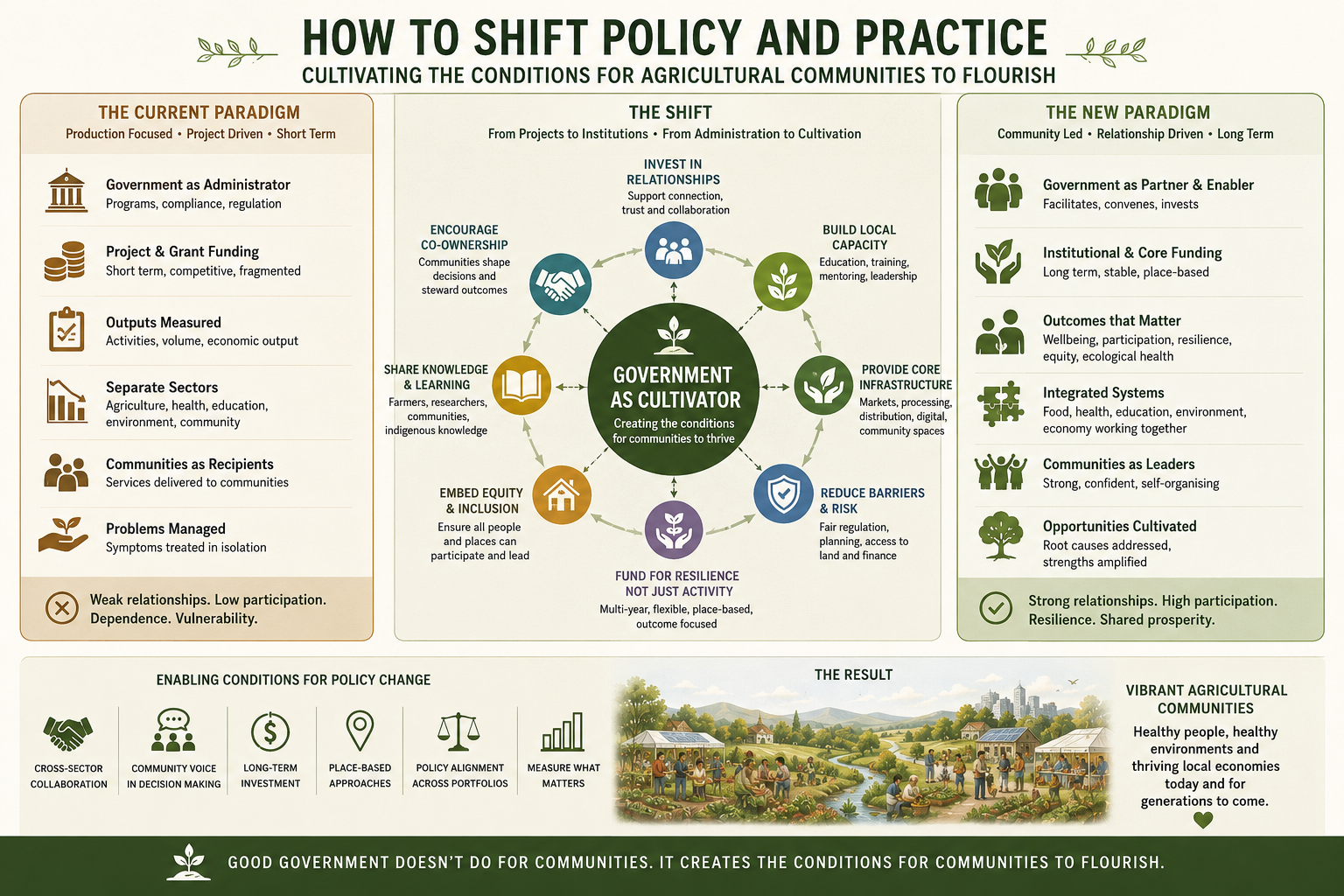
Modern governments have inherited an essential role within this story, yet that role is often misunderstood. The purpose of public institutions is not simply to administer programmes or regulate markets. Their deeper responsibility is to cultivate the conditions within which society itself may flourish. Good government does not replace community. Neither does it abandon community. Rather, it creates the legal, financial, educational and civic conditions through which communities become increasingly capable of assuming responsibility for the common good.
Agricultural policy therefore presents an opportunity to reconsider the relationship between governments and citizens. For much of the twentieth century, agricultural institutions were understandably shaped by the priorities of production, efficiency, trade and food security. These achievements should not be underestimated. They enabled remarkable increases in productivity and contributed significantly to national prosperity. Yet the challenges confronting the twenty-first century are different. Climate instability, declining biodiversity, chronic disease, social isolation, rural depopulation, food insecurity and the erosion of community participation cannot be addressed through production alone. They require institutions capable of strengthening relationships as carefully as they strengthen economies.
This does not imply expanding government indefinitely. On the contrary, it suggests a more intelligent and more relational understanding of governance itself. A government that cultivates life asks different questions.
Instead of asking, How do we deliver another programme? it asks, What capacities already exist within communities, and how might public policy strengthen them?
Instead of asking, How do we solve this problem for citizens? it asks, How might citizens become partners in creating the conditions for shared wellbeing?
Instead of measuring success only through outputs and expenditure, it also asks whether trust, participation, resilience and civic capability have grown stronger.
Such questions require governments to become attentive not only to economic capital but also to social capital, ecological capital and cultural capital. They invite policymakers to recognise that relationships are not secondary outcomes of successful policy but essential public assets deserving deliberate cultivation.
Within this understanding, the role of agricultural policy begins to expand. Agriculture is no longer concerned solely with supporting farms or increasing production. It becomes one of the principal ways through which governments strengthen communities themselves. Every investment in regional food systems simultaneously becomes an investment in public health, education, ecological stewardship, local enterprise and democratic participation. Food ceases to be another sector of government and becomes a meeting place through which multiple public purposes are advanced together.
This perspective also suggests that governments should become more attentive to institutional maturity. Communities continually generate innovative responses to local challenges. Some remain small experiments. Others gradually demonstrate resilience, trust and long-term public value. At present, however, public policy often struggles to distinguish between temporary projects and institutions that are beginning to establish themselves within civic life. Funding cycles conclude just as relationships are becoming established. Reporting requirements frequently privilege measurable outputs over the slower development of community capacity. Organisations are encouraged to innovate repeatedly rather than being supported to deepen and consolidate what has already been learned.
A living systems approach invites another response. Rather than continually asking communities to begin again, governments might ask how they can accompany communities as they mature. Such accompaniment is less concerned with directing activity than with cultivating fertile conditions. It recognises that institutional development resembles ecological succession more than industrial production. Healthy ecosystems are not assembled. They are cultivated. They require continuity, diversity, patience and the freedom to adapt to changing conditions while remaining rooted within place.
The same may be said of food communities.
Government cannot manufacture trust.
It cannot legislate belonging.
It cannot compel neighbours to care for one another.
These qualities emerge through lived experience and shared responsibility. Yet governments can either inhibit or enable the conditions through which such relationships develop. Procurement policies may strengthen regional economies or unintentionally weaken them. Planning regulations may encourage community initiatives or create unnecessary barriers. Funding programmes may reward collaboration or reinforce competition. Educational policy may reconnect children with food systems or continue treating food as peripheral to learning. Every policy decision participates, consciously or unconsciously, in shaping the institutional ecology within which communities live.
This recognition carries profound implications for Canada's Next Agricultural Policy Framework. The question before the government is not simply how to invest more resources into local food systems. The deeper question is whether agricultural policy can become an enabling framework that recognises citizens not merely as consumers of public services, nor farmers merely as producers of commodities, but both as co-creators of resilient communities. Such a framework would acknowledge that public value is generated not only through efficient administration but through the cultivation of relationships capable of sustaining life over generations.
The Con Viv framework proposes precisely this shift. It understands government not as the architect of every solution, but as one participant within a broader ecology of institutions whose shared purpose is the flourishing of life. Within such an ecology, governments provide stability, legitimacy and long-term stewardship; communities contribute creativity, participation and local knowledge; educational institutions cultivate understanding; civil society generates trust and mutual care; and farmers continue their indispensable work as stewards of the landscapes upon which all life depends. None is sufficient alone. Together they form the living fabric of a resilient society.
The challenge before us, therefore, is not to enlarge government nor diminish it, but to deepen its purpose. Public institutions are at their strongest when they cultivate the conditions through which citizens themselves become capable of weaving the common life they wish to inhabit. In this sense, the future of agricultural policy is inseparable from the future of democracy itself, for both ultimately depend upon the same enduring capacity: the human ability to organise, to cooperate and to cultivate life together.
Part VI
The Seven Needles: Seven Acts of Institutional Weaving
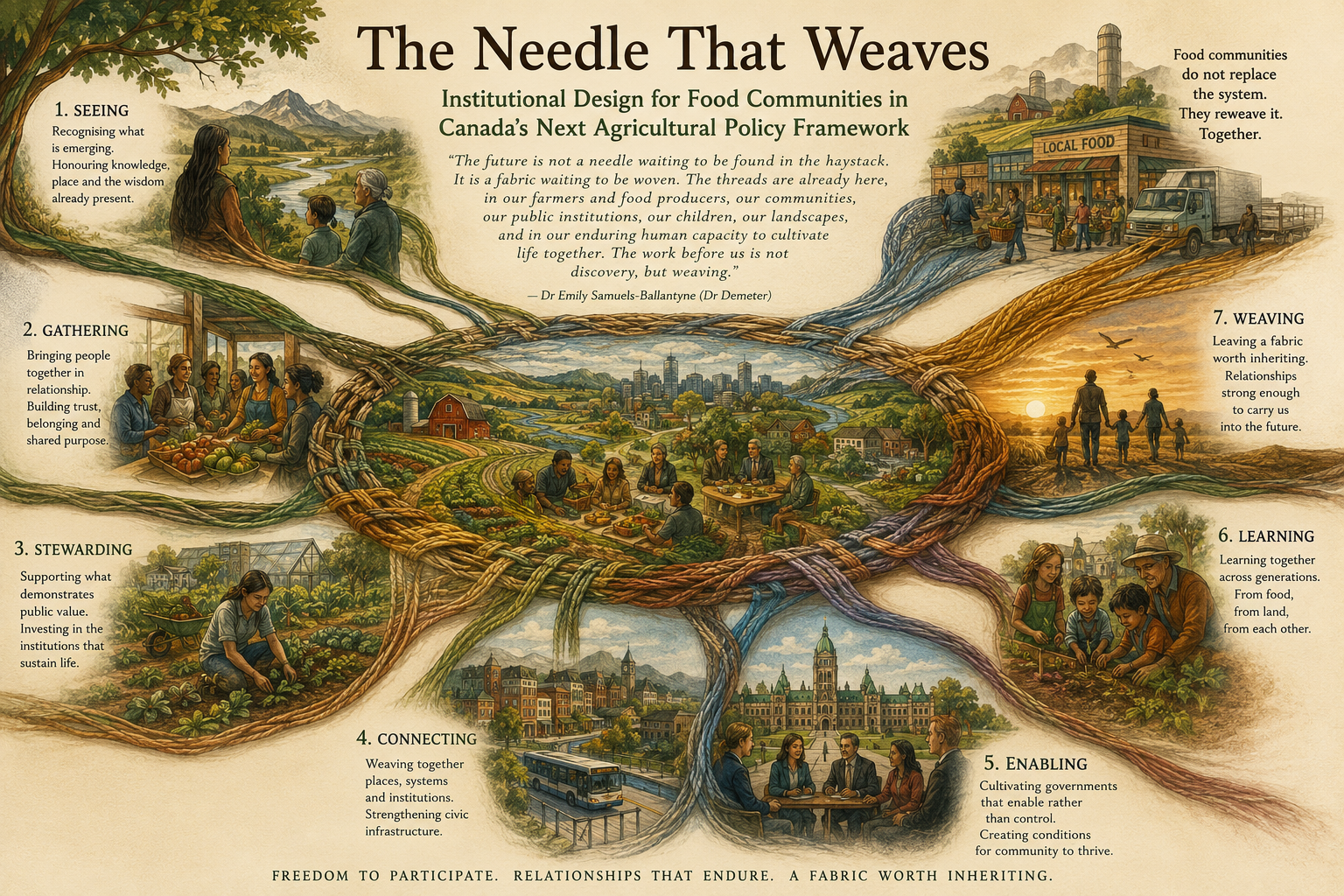
If the future is not a needle waiting to be found but a fabric waiting to be woven, then Canada's Next Agricultural Policy Framework is invited to ask a different question. Rather than searching for the next innovation capable of transforming food systems, we might ask how public policy itself can become an instrument of weaving. The seven needles that follow are offered not as a checklist of programmes but as seven acts of institutional cultivation. Each represents a movement through which governments, communities and citizens participate in creating the social fabric upon which resilient food systems depend.
Needle One: Seeing — Recognising Food Communities as Civic Institutions
Imagine a regional community in British Columbia where a small volunteer food initiative has quietly evolved over many years. What began as a seasonal farmers' market has gradually become something much richer. Local schools purchase produce from nearby farms. Healthcare providers refer patients to community gardens. Municipal planners consult the food partnership when designing neighbourhoods. Indigenous Elders contribute traditional ecological knowledge. Volunteers coordinate harvest celebrations that have become anticipated community events. From the outside it still appears to be a collection of projects. In reality it has become an institution. Its greatest achievement is not the quantity of food distributed but the relationships that have been patiently cultivated over time.
The first responsibility of public policy is therefore recognition. Governments shape reality through what they choose to recognise. When food communities are regarded merely as temporary initiatives they remain dependent upon temporary support. When they are recognised as civic institutions they become worthy of long-term stewardship alongside libraries, schools and community health services.
Con Viv understands recognition as the first movement of institutional design. Before we can cultivate what is emerging, we must first learn to see it.
Needle Two: Gathering — Bringing Citizens, Farmers and Institutions into Relationship
Imagine one thousand families across southern Ontario contributing a modest monthly amount into a community purchasing cooperative. At first glance the initiative appears to be about affordability. Yet something far more significant begins to unfold. Farmers gain confidence to plant according to shared seasonal plans. Schools organise visits to participating farms. Families volunteer during harvest festivals. Local businesses begin supporting regional processing and distribution.
Food becomes the meeting place through which strangers gradually become neighbours. The role of government is not to manage these relationships but to create the conditions through which they may flourish. Procurement policy, cooperative legislation, regional investment and educational partnerships all become threads that strengthen the fabric rather than isolated interventions. Con Viv recognises that living systems organise through relationship before they organise through structure.
Needle Three: Stewarding — Growing Participatory Institutions Rather Than Endless Projects
Imagine a community organisation that has spent ten years successfully delivering food programmes through successive grants. Every few years it is required to reinvent itself to satisfy a new funding priority, despite having already demonstrated its public value. Energy that might otherwise deepen community relationships is continually diverted towards organisational survival. Government now asks a different question, rather than asking whether another project should be funded, it asks whether an institution has emerged. Stable partnerships replace perpetual uncertainty and communities begin planning decades rather than funding cycles. Con Viv reminds us that projects initiate change; institutions allow change to endure.
Needle Four: Connecting — Investing in Places Where Relationships Can Flourish
A former warehouse on the Prairies becomes a regional food commons. Refrigeration, processing, storage and transport all occur within the same building. Yet the building itself is not the transformation. The transformation lies in the conversations taking place around loading docks, kitchen tables and shared meals. Farmers meet teachers. Municipal staff meet volunteers. Young apprentices meet experienced growers. Infrastructure has become relationship. Public investment should therefore support places where communities continually encounter one another through the shared work of nourishment. Con Viv understands infrastructure not simply as physical assets but as environments within which civic relationships mature.
Needle Five: Cultivating — Government as the Gardener of Living Systems
A municipality establishes a Food Community Table where planning, health, agriculture, education, economic development and civil society meet every month. No single department controls the process. Instead, each learns to see food through the eyes of the others. Decisions become more coherent because relationships have become stronger. The government has not expanded. It has become wiser. The purpose of governance is not to direct every thread but to cultivate the conditions through which weaving becomes possible.
Con Viv understands leadership as cultivation rather than control.
Needle Six: Learning — Growing Citizens Through Food
Children harvest vegetables alongside grandparents, Indigenous knowledge holders, local farmers and teachers. Mathematics is learned through planting plans. Biology through soil. History through food traditions. Citizenship through caring for one another.
Food becomes education.
Education becomes community.
Community becomes democracy.
Agricultural policy should recognise these experiences not as enrichment activities but as investments in the capacities upon which democratic societies depend. Con Viv proposes that every healthy food system is also a learning system.
Needle Seven: Weaving — Leaving a Fabric Worth Inheriting
Imagine Canada ten years from now. No single model has spread across the country. Instead thousands of locally distinctive food communities have emerged, each shaped by its own landscape, culture and history. Some are Indigenous-led. Others are centred on municipalities, schools, cooperatives or neighbourhood partnerships. They differ in form yet share a common characteristic.
They have become institutions.
Citizens no longer ask who is responsible for food.
They recognise themselves as participants in its cultivation.
The purpose of agricultural policy has never been to weave the fabric itself.
Its purpose has been to ensure that the conditions for weaving continue from one generation to the next. Con Viv understands this as the highest purpose of institutional design: to leave behind relationships strong enough to be inherited.
Part VII
The Fabric We Leave Behind
This paper began with a simple proposition: that perhaps the future of our food systems does not depend upon finding another solution hidden somewhere beyond our reach, but upon recognising that the capacities required for renewal already exist within our communities and that the work before us is to weave those capacities into enduring institutions.
Over the past twenty years, working with farmers, educators, community organisations, municipalities and universities across Australia, Europe and Canada, I have become less interested in identifying successful projects than in understanding the conditions that allow communities to flourish over time. Again and again I encountered the same pattern. The ideas were already present. The willingness was already present. The knowledge, generosity and commitment were already present. What remained fragmented were the relationships between them.
This is the central contribution of Con Viv. Con Viv begins with the understanding that living systems cannot be assembled through isolated interventions. They are cultivated through relationships that deepen over time until they become the fabric of everyday civic life. Food has simply provided the place where this has become most visible. Through food we encounter ecology, economy, education, health, culture, democracy and community, not as separate policy domains but as one living whole.
The seven needles described in this paper are therefore not seven recommendations to be implemented independently of one another. They are seven movements within a single act of institutional weaving. To recognise what is emerging. To gather people into relationship. To steward what demonstrates public value. To connect through shared civic infrastructure. To cultivate governments that enable rather than control. To learn together through food. And ultimately, to weave institutions capable of being inherited.
This is not a blueprint. Living systems do not require uniform solutions. Every community will express these principles according to its own landscapes, cultures and histories. The task of the government is therefore not to prescribe a single model for Canada, but to cultivate the conditions within which many different forms of community may flourish.
Canada's next Agricultural Policy Framework presents an opportunity to make this shift. It can continue to support agricultural productivity while also recognising that agriculture is one of the great civic practices of a nation. It can invest not only in farms, but in the relationships that connect farms with schools, communities, municipalities, Indigenous knowledge, health, education and regional economies. In doing so, food ceases to be understood simply as a commodity or a sector of government and becomes recognised as a living expression of how society organises itself around care, reciprocity and shared responsibility.
Every generation inherits institutions it did not create. Every generation also leaves institutions behind. The question before us is therefore not simply what policies we wish to write, but what relationships we hope future generations will inherit.
Will they inherit communities capable of organising themselves around nourishment?
Will they inherit institutions that invite participation rather than dependence?
Will they inherit a society that understands food not only as something to consume, but as something through which civic life is continually renewed?
These questions belong to all of us.
Governments have an essential role, not because they weave the fabric themselves, but because they help create the conditions within which weaving becomes possible. Communities, farmers, educators, Indigenous peoples, civil society and citizens each carry threads that no institution can replace. The strength of the fabric depends not upon any single thread, but upon the quality of the relationships that bind them together. The future is not waiting to be discovered, as the threads are already here. The work before us is not discovery but it is to weave.
About the Author:
Dr Emily Samuels-Ballantyne (Dr Demeter) is the Founder and Director of Living Earth College, an international educational and research organisation dedicated to living systems design, regenerative leadership and community renewal. Through Living Earth College, she works across education, policy, research and practice to cultivate the institutional conditions that enable communities, landscapes and food systems to flourish. Her work brings together ecological thinking, civic participation and organisational design to explore how communities can become active partners in shaping more resilient and life-giving futures.
Emily is the originator of Con Viv Design, a living systems framework that reimagines food systems as civic infrastructure and explores how governments, communities, institutions and citizens can cultivate relationships that strengthen both ecological and social resilience. Rather than treating food as simply a commodity or an agricultural sector, Con Viv positions food as a catalyst for rebuilding culture, participation and the social fabric of communities.
Over the past twenty years Emily has worked across Australia, Canada and Europe with universities, municipalities, community organisations, governments, farmers and educational institutions, designing programs that connect policy with practice. Her work spans community food systems, regenerative agriculture, institutional design, participatory governance, leadership education and systems innovation. Most recently, she contributed to the development of regenerative farming education and organisational capacity building with the Earthwsie Society in British Columbia, Canada, supporting the growth of practical learning pathways that connect ecological stewardship with community development.
Emily is also an active policy designer, contributing to public consultations and strategic policy development in Australia, Europe and Canada. Her recent work includes policy positions on community food systems, renewable energy, medicinal plants and institutional innovation, advancing the idea that governments have an essential role not only in supporting agricultural production but also in cultivating the civic institutions that enable communities to participate in the shared work of nourishment.
She holds a Doctor of Philosophy from Swinburne University of Technology, where her research developed Con Viv: Learning to Live with Life, an original contribution to living systems design grounded in food, culture and community. Today, Living Earth College continues to evolve as a centre for education, policy innovation and international collaboration, supporting organisations and communities seeking practical pathways towards regenerative futures.
Living Earth College & Con Viv Design www.livingearthcollege.org & www.convivdesign.org
Acknowledging the Living Conversation
Con Viv Design has emerged through more than two decades of dialogue between practice and scholarship. The ideas presented in this paper have been shaped not only through engagement with the literature below, but through ongoing collaboration with farmers, Indigenous knowledge holders, community organisations, educators, designers, public servants, municipalities and researchers across Australia, Europe and Canada. This bibliography acknowledges an intellectual lineage rather than a complete account of those relationships, recognising that living knowledge is cultivated through both scholarship and practice.
Acknowledgement of Praxis
The ideas presented within this paper have not emerged from scholarship alone. They have been cultivated through more than twenty years of dialogue between research and practice, through farms, communities, public institutions, classrooms, policy processes and countless conversations with people committed to the work of caring for land and one another. I am deeply grateful to the many individuals and organisations who have shaped this journey, often without realising the influence they have had.
Particular gratitude is extended to the communities and organisations whose work has helped illuminate many of the ideas explored within this paper, including Magical Farm Tasmania; the Huon Valley Food Hub; Instaberry Farm in British Columbia; Gagan Singh and the many conversations surrounding community food systems in British Columbia; Earthwise Society in Agassiz, British Columbia; colleagues and collaborators involved in policy design and social innovation across the European Union; and the many farmers, educators, municipal leaders, researchers, Indigenous knowledge holders, volunteers, designers and public servants across Australia, Europe and Canada who have so generously shared their experience, wisdom and questions over many years. Con Viv Design has been woven through these relationships. While the interpretations and proposals contained within this paper remain my own, they have been profoundly shaped by the generosity of people who continue to cultivate living examples of what communities are capable of becoming.
References
Foundational Philosophy and Phenomenology
Alexander, C. (1979). The Timeless Way of Building. Oxford University Press.
Alexander, C., Ishikawa, S., & Silverstein, M. (1977). A Pattern Language: Towns, Buildings, Construction. Oxford University Press.
Bortoft, H. (1996). The Wholeness of Nature: Goethe's Way Toward a Science of Conscious Participation. Lindisfarne Press.
Goethe, J. W. von. (1988). The Metamorphosis of Plants. MIT Press.
Goethe, J. W. von. (1995). Scientific Studies. Princeton University Press.
Naydler, J. (1996). Goethe on Science. Floris Books.
Steiner, R. (1923). Towards Social Renewal. Rudolf Steiner Press.
Steiner, R. (1924). Agriculture Course. Rudolf Steiner Press.
Steiner, R. (1928). The Philosophy of Freedom. Rudolf Steiner Press.
Living Systems and Complexity
Bateson, G. (1972). Steps to an Ecology of Mind. Chandler Publishing.
Capra, F., & Luisi, P. L. (2014). The Systems View of Life: A Unifying Vision. Cambridge University Press.
Mang, P., & Reed, B. (2012). Designing from Place: A Regenerative Framework and Methodology. Building Research & Information, 40(1), 23–38.
Maturana, H., & Varela, F. (1987). The Tree of Knowledge. Shambhala.
Meadows, D. H. (2008). Thinking in Systems. Chelsea Green.
Reed, B. (2007). Shifting from Sustainability to Regeneration.
Senge, P. M. (2006). The Fifth Discipline. Doubleday.
Snowden, D., & Boone, M. (2007). A Leader's Framework for Decision Making. Harvard Business Review, 85(11), 68–76.
Wahl, D. C. (2016). Designing Regenerative Cultures. Triarchy Press.
Wheatley, M. J. (2006). Leadership and the New Science. Berrett-Koehler.
Institutions, Governance and Civic Life
Ansell, C., & Gash, A. (2008). Collaborative Governance in Theory and Practice. Journal of Public Administration Research and Theory, 18(4), 543–571.
Block, P. (2008). Community: The Structure of Belonging. Berrett-Koehler.
Jacobs, J. (1961). The Death and Life of Great American Cities. Random House.
Kooiman, J. (2003). Governing as Governance. Sage.
North, D. C. (1990). Institutions, Institutional Change and Economic Performance. Cambridge University Press.
Ostrom, E. (1990). Governing the Commons. Cambridge University Press.
Ostrom, E. (2005). Understanding Institutional Diversity. Princeton University Press.
Putnam, R. D. (2000). Bowling Alone: The Collapse and Revival of American Community. Simon & Schuster.
Human Development and Conviviality
Illich, I. (1973). Tools for Conviviality. Marion Boyars.
Max-Neef, M. (1991). Human Scale Development: Conception, Application and Further Reflections. Apex Press.
Nussbaum, M. (2011). Creating Capabilities. Harvard University Press.
Schumacher, E. F. (1973). Small Is Beautiful: Economics as if People Mattered. Blond & Briggs.
Sen, A. (1999). Development as Freedom. Oxford University Press.
Food Systems, Agriculture and Regional Development
Marsden, T. (2013). Sustainable Place-Making for Sustainability Science. Edward Elgar.
Morgan, K. (2009). Feeding the City: The Challenge of Urban Food Planning. International Planning Studies, 14(4), 341–348.
Morgan, K., Marsden, T., & Murdoch, J. (2006). Worlds of Food: Place, Power and Provenance in the Food Chain. Oxford University Press.
Renting, H., Marsden, T., & Banks, J. (2003). Understanding Alternative Food Networks. Environment and Planning A, 35(3), 393–411.
Sonnino, R. (2009). Feeding the City: Towards a New Research and Planning Agenda. International Planning Studies, 14(4), 425–435.
Design and Social Innovation
Manzini, E. (2015). Design, When Everybody Designs. MIT Press.
Meroni, A. (2007). Creative Communities: People Inventing Sustainable Ways of Living. Edizioni POLI.design.
Meroni, A., & Sangiorgi, D. (2011). Design for Services. Gower.
Indigenous Knowledge and Reciprocity
Kimmerer, R. W. (2013). Braiding Sweetgrass: Indigenous Wisdom, Scientific Knowledge and the Teachings of Plants. Milkweed Editions.
Whyte, K. P. (Selected publications on Indigenous environmental governance and relational ethics.)
Canadian Policy Context
Agriculture and Agri-Food Canada. (2025–2026). Next Agricultural Policy Framework Consultation Documents.
Canadian Food Policy Advisory Council. Selected reports.
Statistics Canada. Agricultural and Food System Statistics.
Original Contributions
Samuels-Ballantyne, E. (2020). Convivial Food Systems in Everyday Life. Doctor of Philosophy, Swinburne University of Technology.
Samuels-Ballantyne, E. (2026). Con Viv: Learning to Live with Life. Living Earth College.
Samuels-Ballantyne, E. (2026). Food Communities as Civic Infrastructure: A Policy Framework for Rebuilding Local Food Systems. Living Earth College.
Samuels-Ballantyne, E. (2026). Keeping Plants and People Connected. Living Earth College.
Samuels-Ballantyne, E. (2026). The Needle That Weaves: Institutional Design for Food Communities in Canada's Next Agricultural Policy Framework. Living Earth College.