From Compliance to Capability
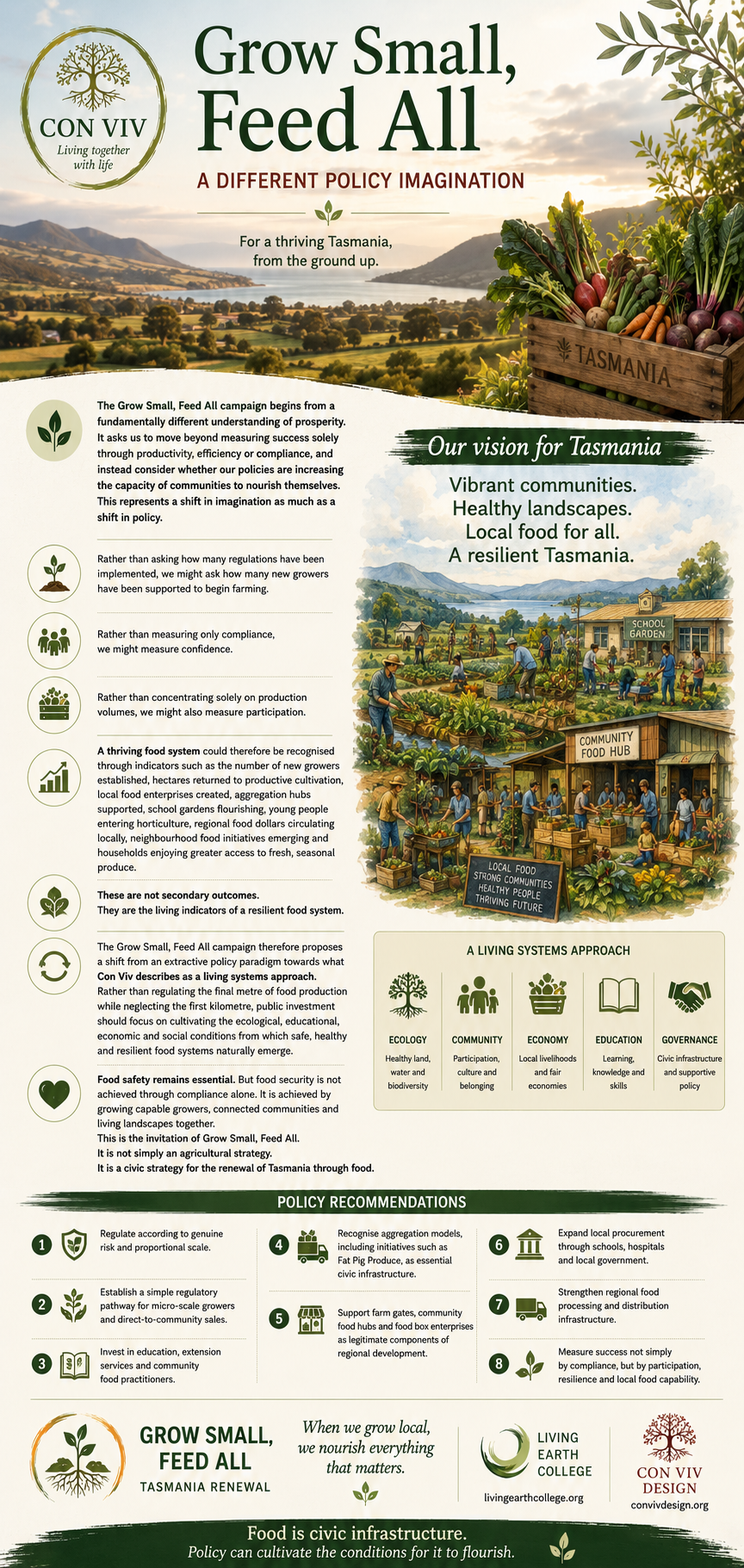
Today, Tasmanian Times published my latest opinion piece exploring Tasmania's proposed Horticulture Regulations and a question that reaches far beyond horticulture:
What is the purpose of public policy?
After recently travelling through Europe and Canada, I returned inspired by the many communities investing in local food resilience, neighbourhood food networks and regional capability. It was therefore deeply concerning to arrive home and discover proposed regulations that could require a home gardener to prepare extensive management documentation simply to exchange a few lettuces or bunches of herbs at a community crop swap.
For an island with extraordinary potential to strengthen household food production, community resilience and food security, this feels like a conversation we cannot afford to ignore.
My article argues that compliance has an important place, but regulation alone cannot create resilient food systems. We also need policies that cultivate capability, trust, participation and the conditions for communities to flourish.
I'm especially grateful to Dr Olivia Rundle for carefully unpacking the legal and policy implications of the proposed regulations. My contribution builds on her work by asking how public policy might better support living systems rather than simply regulate them.
Read the article:
https://tasmaniantimes.com/2026/07/from-compliance-to-capability/
As always, I welcome your reflections. These conversations matter—not only for Tasmania, but for every place seeking to nourish resilient communities in uncertain times.
About the Author
Dr Emily Samuels-Ballantyne is a researcher-practitioner in living systems design, founder of Living Earth College, and developer of the Con Viv framework. For more than two decades she has worked alongside communities, governments, educators and practitioners to design local food systems that strengthen ecological, social and economic resilience.
Writing as Dr Demeter, she explores the deeper cultural, ecological and philosophical questions of our time through the Con Viv Island Almanac, weaving together policy, place, agriculture and the living world in search of more convivial futures.