
From Compliance to Capability: A Response to Tasmania’s Horticultural Regulations
Acknowledgement
This position paper has been written from Magical Farm Tasmania, on Melukerdee Country, in lutruwita / Tasmania, with deep gratitude for the enduring relationship between Country, culture and food that has sustained life on this island for countless generations.
I respectfully acknowledge the Traditional Custodians of Melukerdee Country and pay my respects to Elders past and present. Through relationships fostered within the Huon Valley Food Hub, I have come to appreciate the importance of recognising Melukerdee Country and the enduring wisdom held within this place. I honour the world's oldest continuing food traditions and recognise the profound ecological knowledge, seasonal rhythms and reciprocal relationships with land, water, plants and animals that continue to guide more regenerative ways of living.
The Con Viv Framework is founded on the understanding that food is far more than a commodity. Food is relationship. Food is culture. Food is memory. Food is belonging. Every healthy food system begins with care for Country and with the recognition that human wellbeing cannot be separated from the health of the living world.
This work has also been shaped by the many farmers, gardeners, Aboriginal knowledge holders, researchers, educators, designers, communities and organisations who continue to cultivate more just, resilient and life-giving food systems. Their work reminds us that the future of food will not be secured through regulation alone, but through stewardship, participation, reciprocity and our shared responsibility to care for the places that nourish us.
May this contribution honour both ancient and emerging knowledge and contribute to a future in lutruwita / Tasmania where more people grow food, more communities nourish themselves, more landscapes flourish, and future generations inherit a living food system grounded in care, reciprocity and belonging.
"To live well is to live with life."
— Con Viv: Learning to Live with Life
Executive Statement
The proposed Tasmanian Horticultural Produce Regulations present an important opportunity to strengthen food safety across large-scale commercial supply chains. However, they also risk undermining one of Tasmania's greatest long-term assets: a resilient, decentralised local food system capable of strengthening food security in an increasingly uncertain world. By applying industrial regulatory frameworks to fundamentally different small-scale food systems, the regulations may unintentionally discourage the very growers and community enterprises that build local food resilience.
This policy position supports proportionate food safety regulation while recommending that genuine direct-to-consumer growers be exempt from the proposed regulations. This exemption should apply to growers who sell directly to consumers through farm gates, community-supported agriculture (CSA), vegetable box schemes, local food hubs, farmers' markets and similar short supply chains where transparency, trust and accountability are inherent in the relationship between grower and consumer. These systems differ fundamentally from anonymous, high-volume commercial distribution networks and should therefore be regulated according to their actual level of risk rather than through a one-size-fits-all framework.
At its heart, this proposal is about food security. Tasmania produces far more food than its population consumes, yet much of the food purchased by Tasmanians still travels through long, complex supply chains that remain vulnerable to disruption from economic shocks, transport failures, climate events and global market instability. A resilient food system depends not only on large-scale production but also on thousands of small growers, local markets and community food enterprises that increase local self-reliance, diversify food distribution and strengthen regional capability.
The proposal is founded on a simple principle: different food systems require different forms of governance. Industrial supply chains require comprehensive regulatory oversight because food passes through multiple intermediaries before reaching consumers. Community food systems operate through direct relationships, local knowledge and shared accountability. Public policy should recognise these differences rather than treating all horticultural production as though it exists within the same industrial model.
The paper also argues that regulation alone cannot deliver food security. Alongside appropriate food safety measures, Tasmania should invest in the capability of local food systems through extension services, ecological horticulture training, regional aggregation and distribution, local processing infrastructure, public procurement, and community food enterprises. These investments would expand local food production, strengthen regional economies, and increase the state's capacity to respond to future disruptions.
The Con Viv Framework presented in this paper understands food systems as civic infrastructure rather than simply agricultural supply chains. Small farms produce far more than vegetables; they cultivate healthy soils, biodiversity, practical skills, local employment, neighbourhood relationships and community resilience. Together, these outcomes form the social, ecological and economic foundations of long-term food security.
The central recommendation is therefore clear: exempt genuine direct-to-consumer growers from regulations designed for industrial supply chains while investing in the living conditions that enable many more growers, stronger communities and a resilient Tasmanian food system. Food security is not achieved through regulation alone; it is created by enabling diverse, distributed and locally connected food systems to flourish. This is the foundation of the Grow Small, Feed All policy vision.
The Policy Paradox: Growing More Local Food is the Public Health Strategy
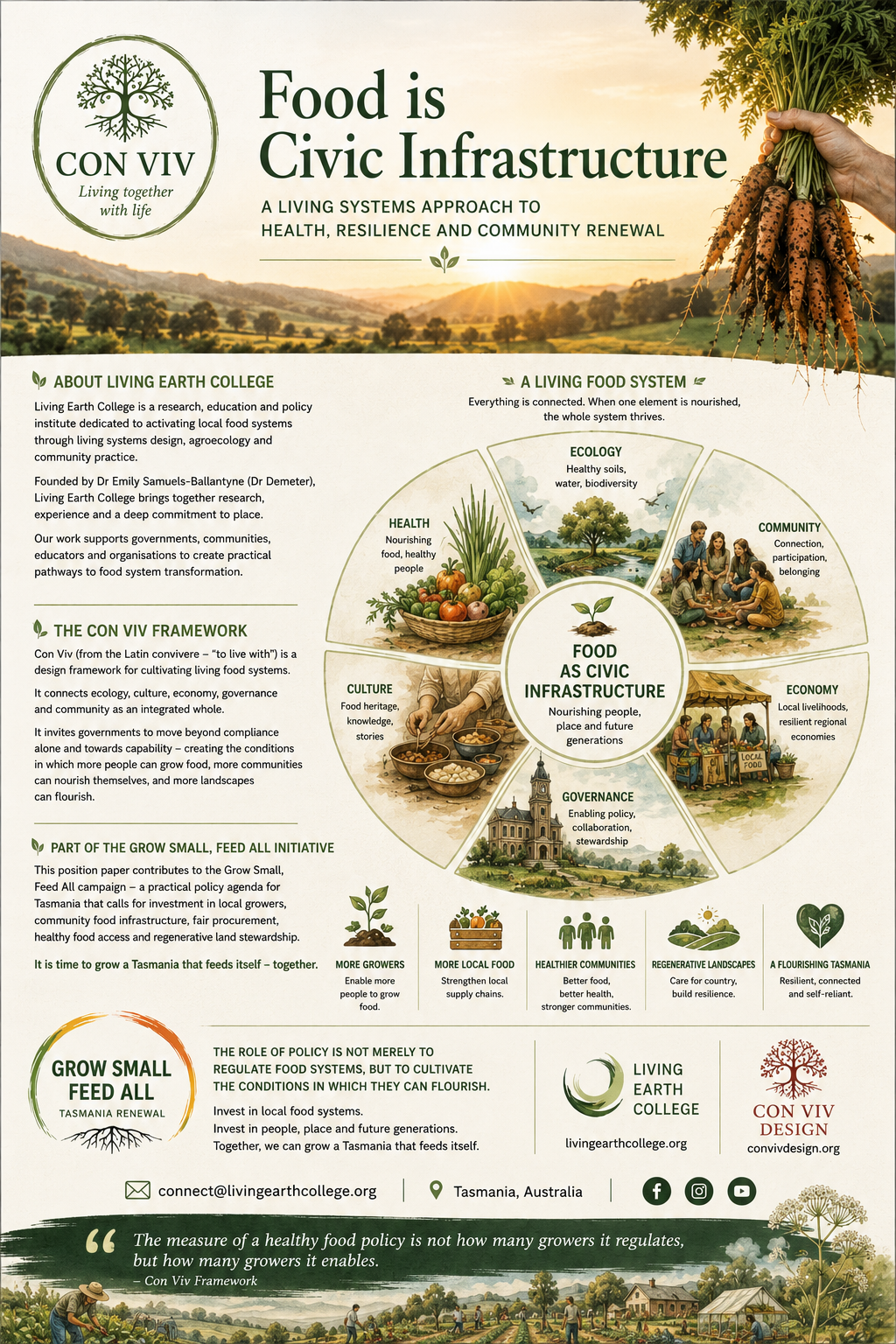
Tasmania rightly values food safety and maintains one of the world's strongest biosecurity systems. Biosecurity Tasmania plays an essential role in protecting the State from exotic pests and diseases by requiring inspections, certifications and, for some imported plant products, treatments such as methyl bromide fumigation, irradiation or other approved biosecurity measures before entry into Tasmania. These measures protect agriculture from external biological threats.
However, this consultation asks the wrong policy question. If the objective is to improve public health, why is regulatory attention being directed towards small-scale growers selling vegetables directly to their neighbours, while the much larger public health challenge, the industrial food system itself, remains largely unexamined?
Public health is not simply about protecting people from foodborne illness. It is also about ensuring that every child has access to fresh, nutrient-dense food grown in healthy soils and produced in ways that support both human and ecological wellbeing. A food system that relies on long supply chains, highly processed foods, chemically intensive production systems and declining nutritional quality cannot be addressed through compliance requirements placed on local market gardeners alone.
Across lutruwita / Tasmania, small-scale growers are producing fresh vegetables, herbs and fruit using regenerative and ecological farming practices that build soil fertility, increase biodiversity and strengthen local food resilience. Many work with minimal or no synthetic chemical inputs, selling directly to families through farm gates, vegetable box schemes, farmers' markets and community food hubs. These growers are not simply producing food; they are cultivating health, knowledge, community connection and ecological stewardship.
If we are serious about improving public health, our policy ambition should be to make this kind of food more accessible, particularly for children. Every child should have the opportunity to eat fresh, locally grown produce that is harvested at peak ripeness, rich in nutrients, and produced in ways that regenerate the landscapes upon which future generations depend. This requires policies that expand local food production and strengthen community food infrastructure, rather than creating additional barriers for the very growers helping to realise that vision. The central question, therefore, is not How do we regulate more small growers? How do we enable thousands more people to grow and share healthy food within their communities? That is the public health opportunity before Tasmania.
Across conventional agriculture, the routine use of herbicides such as glyphosate, fungicides and insecticides is regulated through Australia's agricultural chemical framework, with residues managed through national standards. The question for Tasmania is not simply whether those residues comply with legal limits. The deeper policy question is whether we should continue increasing our dependence on long, chemically intensive supply chains when a healthier alternative already exists. =Every new market gardener, farm gate, vegetable box, community-supported agriculture scheme and local food hub reduces reliance on distant supply chains and increases access to fresh food grown close to home. Every local grower strengthens food security, builds community resilience, local ecology, supports regional economies and gives Tasmanians greater choice about how their food is produced. This is the policy paradox. Tasmania's biosecurity system works hard to protect the State from imported pests and diseases, yet these proposed regulations risk making it more difficult for the very growers who offer the shortest, freshest and most transparent food supply chains available.
The public health opportunity is therefore not to impose industrial compliance systems on community growers. It is to grow thousands more small-scale growers across Tasmania. A resilient Tasmania will not be built by regulating away local food production. It will be built by enabling local people to grow, distribute and eat more fresh food from healthy Tasmanian landscapes, reducing dependence on industrial supply chains while strengthening the wellbeing of communities for generations to come.
Regulating Growers While Neglecting the Conditions for Growing
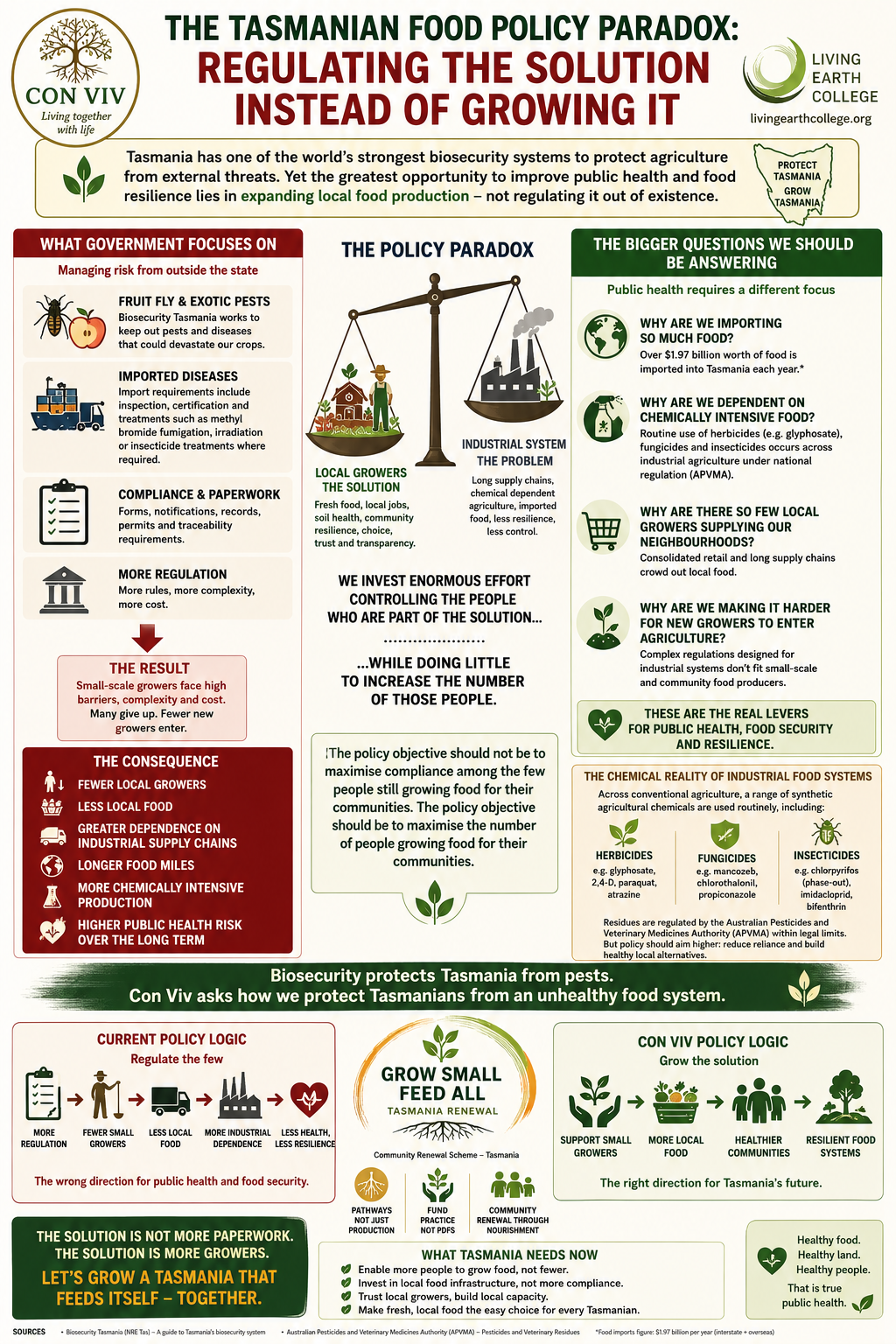
If we look carefully at the direction of contemporary food policy, a curious paradox begins to emerge. Across Tasmania, increasing attention is being devoted to compliance, traceability, accreditation and administration. These are undoubtedly important components of protecting public health, yet they represent only the visible surface of a much larger living system. They concern the governance of food once a grower already exists, while giving comparatively little attention to the conditions required for growers, communities and regional food economies to emerge in the first place. Living systems rarely respond well to regulation in isolation. They flourish when the conditions for life are cultivated. A forest is not sustained because individual trees comply with a set of rules; it thrives because countless relationships between soil, fungi, water, insects, animals and plants continually regenerate one another. Food systems are no different. They are ecological communities before they are economic systems, and social relationships before they become supply chains.
This raises a series of important questions that remain largely absent from the current conversation. If we expect more people to grow food professionally, where are the extension officers supporting new market gardeners as they establish viable enterprises? Where are the apprenticeships that cultivate practical horticultural knowledge alongside business capability? Where are the community food practitioners working within local government to connect growers, schools, health services and neighbourhoods? Where are the regional aggregation hubs that enable small producers to cooperate rather than compete, or the local processing facilities that allow value to remain within regional economies? Where are the procurement policies that ensure public institutions become reliable customers for local farmers?
These are not peripheral questions. They are foundational questions. They concern the ecological and social infrastructure from which resilient food systems arise. Policy cannot continue to demand capability without investing in capability. Nor can compliance become a substitute for community development. A resilient food system is not created by regulation alone, but through the patient cultivation of education, trust, participation, infrastructure and relationships. If we genuinely wish to strengthen food security in Tasmania, then public investment must extend beyond regulating the harvest to nurturing the living conditions from which healthy harvests continually emerge.
Magical Farm: A Living Policy Laboratory
For 7 years Magical Farm Tasmania has quietly explored what this broader understanding of food policy might look like in practice. The farm has never been conceived simply as a place for producing vegetables. Rather, it has become an ongoing experiment in cultivating the relationships that enable communities to participate in food as a living system.
On any given day, neighbours arrive at the farm gate to collect seasonal produce. Volunteers gather around compost bays, discovering that soil is not simply a growing medium but a living community in its own right. School groups wander through gardens asking where carrots come from and why worms matter. Workshops become opportunities not merely to transfer knowledge, but to rebuild confidence, practical capability and a sense of belonging to place. Conversations emerge as naturally as the vegetables themselves, weaving together questions of ecology, health, economics and community. In this sense, the harvest extends far beyond what is carried home in a basket.
The emergence of Fat Pig Produce revealed another dimension of what food can become when viewed through a civic lens. While appearing to be a modest farm gate enterprise, it functioned as something much more significant. It became an aggregation point through which the harvests of many small growers could be brought together, shared and celebrated within the local community. Produce travelled shorter distances, relationships grew stronger, and local economic value remained circulating within the region. Trust replaced anonymity, and cooperation gradually displaced isolation. From a conventional economic perspective, these activities may appear small. Yet from the perspective of living systems they represent essential civic infrastructure. They generate knowledge, strengthen relationships, build local capability and create opportunities for participation that no supermarket transaction can replicate. They remind us that food is not merely exchanged through markets; it is woven through communities.
Magical Farm therefore offers more than an individual example. It demonstrates that another policy imagination is possible. It suggests that governments need not choose between food safety and community food systems. Instead, they can recognise and invest in the places where both are cultivated together. The lessons emerging from a small farm gate in southern Tasmania are not simply local stories; they are evidence that resilient food systems are built through relationships long before they are measured through regulation.
The Peach & Pear Food Box: Designing Distribution as a Living Relationship
The Peach & Pear Food Box began with a deceptively simple question. What would happen if distribution were designed not simply to move food, but to cultivate relationships? Conventional food systems tend to understand distribution as a logistical exercise. The objective is efficiency: moving products from farm to consumer as quickly and cheaply as possible. While this approach has undoubtedly increased the availability of food, it has often done so by stretching the distance between people and place. Growers become anonymous suppliers. Consumers become anonymous purchasers. Food travels efficiently, yet the relationships from which healthy food systems emerge become increasingly fragile.
The Peach & Pear Food Box explored another possibility. It was never simply a vegetable box. It was an experiment in redesigning the social architecture of food itself. Each box became a meeting place between grower and household, between seasonal abundance and everyday meals, between regional economies and community wellbeing. Produce arrived carrying stories of weather, soil, harvest and care. Households began eating with the seasons rather than expecting strawberries in winter and tomatoes every month of the year. Growers gained confidence knowing the people who valued their work, while customers discovered that food could once again become an expression of place rather than simply a product on a shelf.
Distribution therefore ceased to be merely logistics. It became an act of relationship-building. Every delivery strengthened networks of reciprocity, trust and participation. Every food box quietly demonstrated that food systems are capable of generating forms of social wealth that conventional economic measures rarely acknowledge. The value of these systems cannot be measured solely by kilograms sold or dollars exchanged, but by the confidence they cultivate, the knowledge they preserve and the relationships they strengthen. Viewed through the lens of Con Viv, distribution itself becomes civic infrastructure. It is one of the ways communities continually weave themselves together through food.
Food Systems are Living Systems
One of the enduring limitations of contemporary food policy is that it frequently treats food as though it were simply another industrial supply chain. Yet food is fundamentally different from almost every other economic activity because it begins with living soil and ends with living people. Food systems are therefore living systems. They are simultaneously ecological, economic, educational, cultural and relational. They connect farmers with families, landscapes with livelihoods, biodiversity with public health, and local enterprise with community wellbeing. Every meal is the visible expression of countless invisible relationships between microorganisms, seeds, insects, rainfall, growers, transporters, cooks and communities. To understand only the economic transaction is to overlook the living ecology that makes the transaction possible.
This understanding has profound implications for public policy. A small market garden is rarely just a business. It is a place where soil is regenerated, pollinators find habitat, practical knowledge is transmitted between generations, young people discover meaningful work, neighbours meet one another, and local wealth continues to circulate within regional communities. Such places contribute simultaneously to biodiversity, public health, climate resilience, ecological literacy and regional economic development. Conversely, when a small grower disappears, the community loses far more than a supplier of vegetables. It loses practical capability. It loses accumulated local knowledge. It loses another opportunity for meaningful participation in community life. It loses resilience. One more thread is removed from the intricate fabric that enables communities to feed themselves with confidence and dignity. The question before policy is therefore not simply how to regulate food systems, but how to regenerate them.
Grow Small, Feed All: A Different Policy Imagination
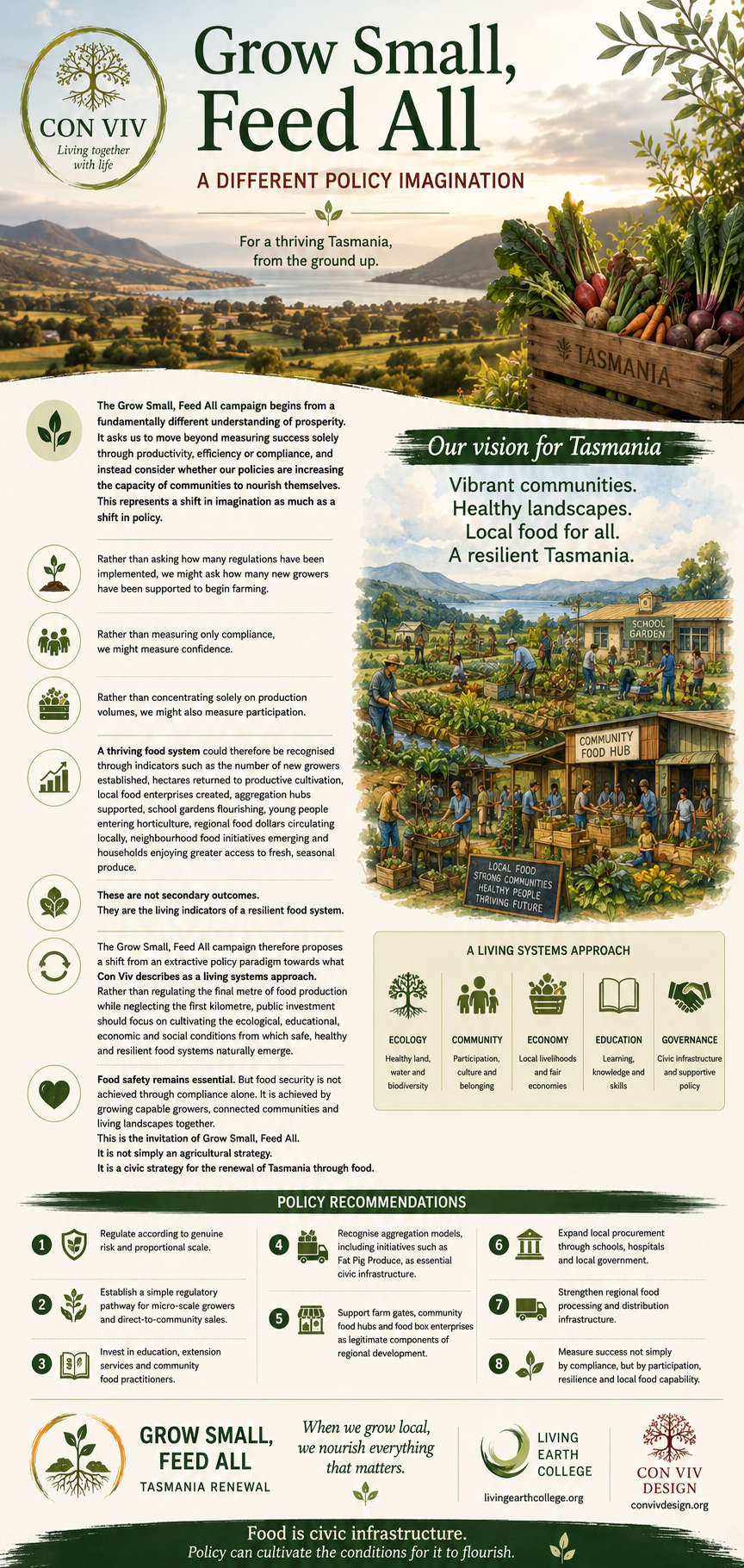
The Grow Small, Feed All campaign begins from a fundamentally different understanding of prosperity. It asks us to move beyond measuring success solely through productivity, efficiency or compliance, and instead consider whether our policies are increasing the capacity of communities to nourish themselves. This represents a shift in imagination as much as a shift in policy. Rather than asking how many regulations have been implemented, we might ask how many new growers have been supported to begin farming. Rather than measuring only compliance, we might measure confidence. Rather than concentrating solely on production volumes, we might also measure participation.
A thriving food system could therefore be recognised through indicators such as the number of new growers established, hectares returned to productive cultivation, local food enterprises created, aggregation hubs supported, school gardens flourishing, young people entering horticulture, regional food dollars circulating locally, neighbourhood food initiatives emerging and households enjoying greater access to fresh, seasonal produce.
These are not secondary outcomes. They are the living indicators of a resilient food system. The Grow Small, Feed All campaign therefore proposes a shift from an extractive policy paradigm towards what Con Viv describes as a living systems approach. Rather than regulating the final metre of food production while neglecting the first kilometre, public investment should focus on cultivating the ecological, educational, economic and social conditions from which safe, healthy and resilient food systems naturally emerge.
Food safety remains essential. But food security is not achieved through compliance alone. It is achieved by growing capable growers, connected communities and living landscapes together. This is the invitation of Grow Small, Feed All. It is not simply an agricultural strategy. It is a civic strategy for the renewal of Tasmania through food.
Policy Recommendations: A Con Viv policy framework recommends that Tasmania:
regulate according to genuine risk and proportional scale;
establish a simple regulatory pathway for micro-scale growers and direct-to-community sales;
invest in education, extension services and community food practitioners;
recognise aggregation models, including initiatives such as Fat Pig Produce, as essential civic infrastructure;
support farm gates, community food hubs and food box enterprises as legitimate components of regional development;
expand local procurement through schools, hospitals and local government;
strengthen regional food processing and distribution infrastructure;
measure success not simply by compliance, but by participation, resilience and local food capability.
Conclusion: Growing the Conditions for Life
The future of Tasmania's food system will not be secured through compliance alone. It will be secured through the countless relationships that emerge whenever people are trusted, equipped and encouraged to grow food together. Public policy must concern itself not only with regulating the harvest, but with cultivating the ecological, economic and social conditions from which healthy harvests continually arise.
Food is not merely an agricultural commodity. It is civic infrastructure. When we invest in small-scale growers, we are investing in healthier communities, stronger regional economies, living landscapes and a more resilient Tasmania. The purpose of policy should therefore be larger than managing risk. Its purpose should be to cultivate the conditions in which life can flourish. That is the invitation of Con Viv. And it is the vision at the heart of Grow Small, Feed All.
From Compliance to Capability: Reframing the Story
Much of contemporary food policy begins from a perfectly understandable concern: how do we minimise risk within increasingly complex food systems? The result has been an extraordinary investment in standards, compliance, traceability and administration, all of which play an important role in protecting public health. Yet somewhere along the way we have quietly accepted the assumption that stronger food systems emerge primarily through better regulation, and in doing so have overlooked a far older and perhaps more important truth, that living systems are not strengthened principally by controlling their parts, but by cultivating the conditions from which health continually arises.
Anyone who has spent time in a garden knows this instinctively. When a crop struggles, our attention is drawn less to the leaves than to the soil, the moisture, the microbial life, the diversity of species and the countless relationships that together make growth possible. The gardener understands that vitality cannot be manufactured at the point of harvest; it is cultivated season by season through patient attention to the conditions that allow life to organise itself well. It is curious that we understand this so readily in ecology, yet so rarely in public policy.
The conversation surrounding small-scale horticulture in Tasmania reflects this wider pattern. We have become increasingly skilled at discussing what growers should do once they are already producing food, while giving comparatively little attention to how communities might cultivate more growers in the first place. The deeper policy question is therefore not simply how to regulate those who already exist, but how to create the ecological, educational and economic conditions in which thousands more people are both capable of, and confident in, growing food for their communities.
This shift in perspective changes almost everything. It asks us to see extension officers, apprenticeships, community food practitioners, aggregation hubs, farm gates, local processing facilities and public procurement not as isolated programs competing for limited funding, but as interconnected pieces of the civic infrastructure through which resilient food systems continually regenerate themselves. These are not peripheral investments added after regulation has been written; they are the fertile ground from which safe food, capable growers and thriving regional economies emerge together.
From this perspective, regulation finds its proper place. It remains essential, but it ceases to carry the impossible burden of creating resilience on its own. Compliance can reduce risk, yet it cannot mentor a young grower through their first season, restore exhausted soils, rebuild regional processing, strengthen neighbourhood relationships or inspire another generation to see farming as meaningful work. These capacities emerge only where policy attends to the living conditions from which food systems themselves arise.
Perhaps, then, the challenge before Tasmania is not to write ever more sophisticated rules for small growers, but to recover a simpler form of common sense: that healthy harvests begin long before the harvest itself. They begin in healthy soils, knowledgeable people, connected communities and public institutions willing to invest in the long work of cultivating capability rather than merely administering compliance. Seen in this light, the question is no longer whether small growers require regulation; it is whether we have the imagination to recognise them as one of our greatest public assets, and to shape policy around helping many more of them flourish.
References
Con Viv Framework
Samuels-Ballantyne, E. (2026). Con Viv: Learning to Live with Life. Living Earth College.
Samuels-Ballantyne, E. (2020). The Con Viv Designing Food Systems in Everyday Life. Swinburne University of Technology
Samuels-Ballantyne, E. (2026). Grow Small, Feed All: Tasmania Renewal Campaign. Con Viv Design.
Samuels-Ballantyne, E. (2026). Activating Local Food Systems. Living Earth College.
Samuels-Ballantyne, E. (2026). Food Communities as Civic Infrastructure: A Policy Framework for Rebuilding Local Food Systems. Living Earth College / Con Viv Design. Available at Academia
Con Viv Design https://convivdesign.org & Living Earth College https://livingearthcollege.org
Agroecology & Food Systems
Altieri, M. (2018). Agroecology: The Science of Sustainable Agriculture.
Gliessman, S. R. (2015). Agroecology: The Ecology of Sustainable Food Systems.
Pretty, J. (2002). Agri-Culture: Reconnecting People, Land and Nature.
Montgomery, D. R. (2007). Dirt: The Erosion of Civilizations.
Montgomery, D. R., & Biklé, A. (2022). What Your Food Ate.
Kittredge, D. (Bionutrient Food Association). https://www.bionutrient.org
Localisation, Food Sovereignty & Community Economies
Berry, W. (1977). The Unsettling of America: Culture and Agriculture.
Berry, W. (2009). Bringing It to the Table.
Norberg-Hodge, H. (1991). Ancient Futures.
Norberg-Hodge, H. (2019). Local Is Our Future.
Shiva, V. (2000). Stolen Harvest: The Hijacking of the Global Food Supply.
Shiva, V. (2008). Soil Not Oil.
Shiva, V. (2016). Who Really Feeds the World?
Via Campesina. https://viacampesina.org
Systems Thinking & Living Systems
Capra, F., & Luisi, P. L. (2014). The Systems View of Life.
Meadows, D. H. (2008). Thinking in Systems.
Ostrom, E. (1990). Governing the Commons.
Senge, P. (2006). The Fifth Discipline.
Design for Social Innovation & Systemic Design
Manzini, E. (2015). Design, When Everybody Designs.
Manzini, E. (2022). Livable Proximity.
Meroni, A. (Ed.). (2007). Creative Communities: People Inventing Sustainable Ways of Living.
Meroni, A. (Ed.). (2013). Design for Social Innovation.
Irwin, T. (2015). Transition Design: A Proposal for a New Area of Design Practice.
DESIS Network. https://www.desisnetwork.org
Systemic Design Association. https://systemic-design.net
Ecological & Foundational Economics
Schumacher, E. F. (1973). Small Is Beautiful: Economics as if People Mattered.
Raworth, K. (2017). Doughnut Economics.
Mazzucato, M. (2021). Mission Economy.
Foundational Economy Collective. (2022). Foundational Economy: The Infrastructure of Everyday Life. Manchester University Press. (De Gruyter Brill)
Agricultural Chemicals, Public Health & Food Regulation
Australian Pesticides and Veterinary Medicines Authority (APVMA). https://www.apvma.gov.au
Food Standards Australia New Zealand (FSANZ). https://www.foodstandards.gov.au
International Agency for Research on Cancer (IARC). Some Organophosphate Insecticides and Herbicides (Monograph 112). https://monographs.iarc.who.int
World Health Organization (WHO). https://www.who.int
Food and Agriculture Organization of the United Nations (FAO). https://www.fao.org
Tasmania
Department of Natural Resources and Environment Tasmania.
Biosecurity Tasmania. https://nre.tas.gov.au
Tasmanian Government. Tasmanian Agri-Food ScoreCard. https://nre.tas.gov.au
About Living Earth College & the Con Viv Framework
Living Earth College is a research, education and policy institute dedicated to activating local food systems through living systems design, agroecology and community practice. Founded by Dr Emily Samuels-Ballantyne (Dr Demeter), Living Earth College has developed the Con Viv Framework, an original approach to food systems that positions food as civic infrastructure. Rather than treating food as simply an agricultural commodity, Con Viv understands it as the living relationship between ecology, community, economy, governance and culture.
The framework draws upon traditions in agroecology, systemic design, living systems thinking, ecological economics, localisation and the foundational economy while contributing a distinctive proposition: the role of public policy is not merely to regulate food systems, but to cultivate the conditions in which they can flourish.
This position paper forms part of the broader Grow Small, Feed All initiative, a practical policy agenda that seeks to strengthen Tasmania's local food resilience by enabling more people to grow food, shortening supply chains, supporting regional economies and improving public health through community-scale food production. Living Earth College works with governments, communities, educators and organisations to develop practical, place-based approaches to food systems transformation through policy design, education, research and demonstration.
Con Viv's central proposition is simple: Food is civic infrastructure.
When we invest in local food systems, we simultaneously invest in healthier landscapes, stronger communities, more resilient regional economies and a flourishing Tasmania.
Living Earth Collegelivingearthcollege.org
Con Viv Designconvivdesign.org
Grow Small, Feed All: A Con Viv policy initiative for community food resilience.
"The measure of a healthy food policy is not how many growers it regulates, but how many growers it enables."— Con Viv Framework
"To live well is to live with life."
— Con Viv: Learning to Live with Life
Get In Touch
Please get in touch if you would like to add to this proposal and improve food policy in Tasmania.
connect@livingearthcollege.org