The Architecture of Wholeness: Designing Life from the Ground Up
What a Florentine basilica reveals about food systems, education, governance and the task of designing life now
A Wall That Still Speaks
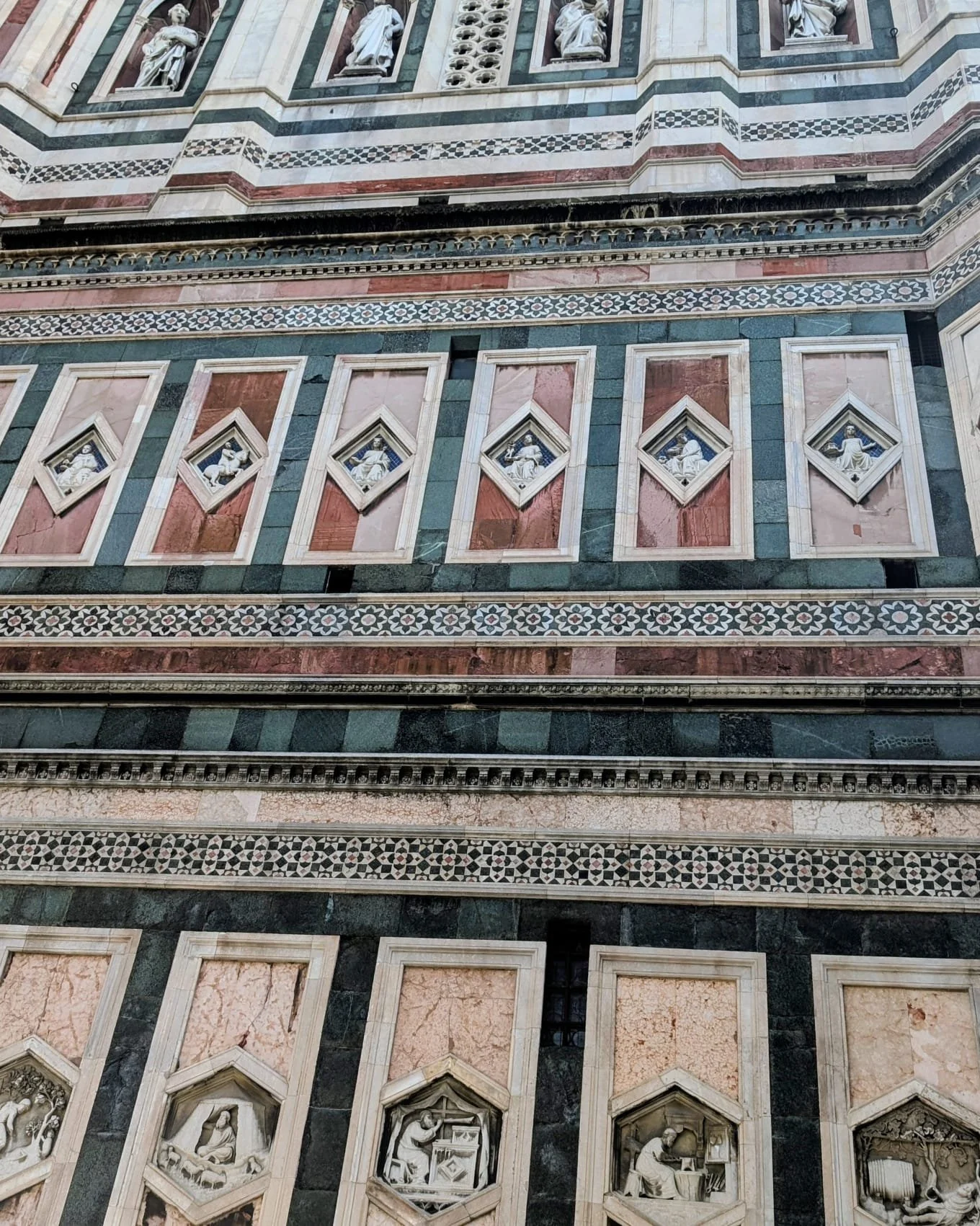
On the side of a Florentine basilica, the wall itself becomes a form of teaching, through its symbolic arrangement and proportion, as though the city once understood that architecture can carry philosophy and that public space could quietly educate the eye, the mind and the soul. At first glance it appears to be ornament, green and rose marble, carved reliefs, saints in their niches, geometric order laid out with such elegance that one could pass by and admire only its beauty, yet when one pauses and looks more closely another language begins to emerge, for the façade is arranged in layers and each one speaks to a different dimension of civilisation.
In the Florentine imagination, and especially in readings of facades such as Santa Maria Novella, one can perceive a threefold movement. The lower register evokes earthly life, commerce, patronage, labour and the material ground of society. The middle zone mediates, interprets and connects, standing almost as a threshold between necessity and aspiration. The upper realm gestures toward the heavenly, the sacred, the realm of meaning beyond mere utility. Whether read architecturally, socially or spiritually, the gesture remains potent. A living culture must nourish material life, cultivate understanding and remain answerable to meaning.
What moved me most standing before such walls was not only their beauty, but their practicality. Because what is the point of history and philosophy if we do not design from their insights? What is the point of studying social forms, spiritual symbols, civic cosmologies and old pedagogies if they do not help us create wiser institutions, healthier food systems, more life serving governance and more meaningful education now? We do not need reverence without application - we need praxis, which is something I noticed in my arts degree, a wonderful way to critique, perceive and understand but there was a lack of how we design forward…. We need forms through which insight can become structure, and contemplation can become participation.
Photography by Emily Samuels-Ballantyne
The Ground Where Culture Begins
At the lower level are the practical arts of earthly life, farming, tending animals, building, weaving, exchange, communication and law, all those ordinary and necessary activities through which a society feeds itself, clothes itself, shelters itself and carries continuity from one generation to the next. Here the human being is not imagined as a consumer detached from place, but as a participant in the making of life, a cultivator, a maker, a steward. Food, shelter, tools and trade are not lesser concerns. They are the ground from which culture grows. Whenever a civilisation forgets the primacy of nourishment, place and livelihood, it begins to float above the conditions that sustain it.
In Tasmania this fracture is visible across the food system. Small farmers are squeezed while supermarket concentration deepens. Procurement structures favour scale over resilience. Policy often speaks the language of productivity while overlooking circulation, community health, local capability and the real conditions that make regional life viable. This is why Grow Small Feed All matters as more than a campaign. It is a policy reorientation grounded in the understanding that a healthy food system is not built through extraction and consolidation alone, but through a distributed ecology of small and medium producers, local processing, community infrastructure, regional procurement, practical training and civic participation.
Food is never only commodity. Food is relationship, metabolism, memory, livelihood and culture. It is one of the primary ways a place either remembers itself or forgets itself. When food systems are hollowed out, communities do not merely lose calories or market diversity. They lose skill, dignity, reciprocity and resilience. A living food policy must therefore be more than economic management. It must be cultural design.

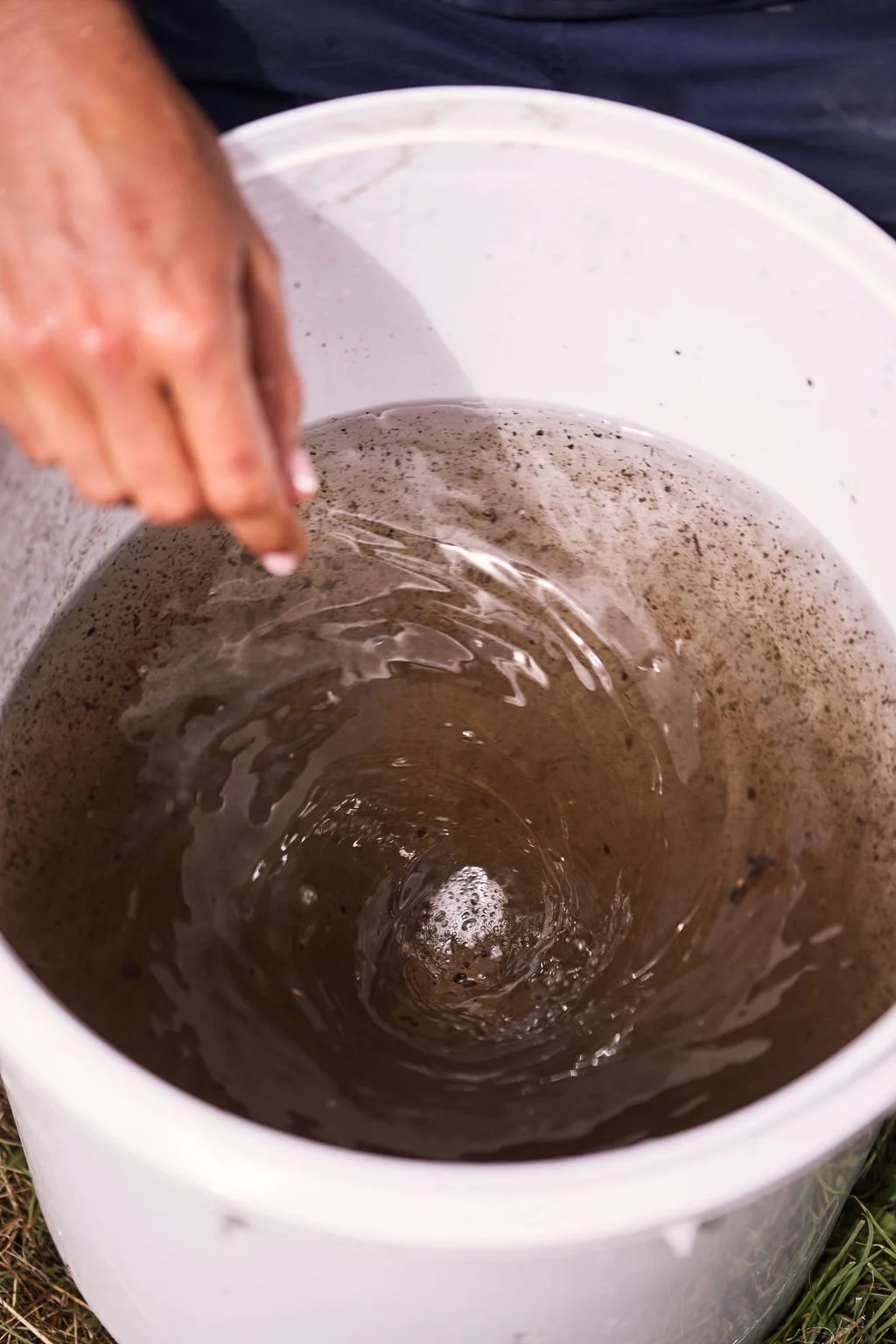
Making medicine (one representation on the lower realm) ‘hands’ - Photography by Emily Samuels-Ballantyne
Learning to Read the Living World
Above this lower realm sits the middle layer, the sciences and liberal arts, astronomy, music, geometry, medicine, grammar, reason, the realm in which the human being seeks not merely to manage life but to understand it, to perceive pattern, proportion and relationship. This is the layer of the head, though not intellect alone. It is the cultivation of perception. In older traditions music was harmony, astronomy was cosmic order, geometry was measure, all disciplines through which one learned to read the world more deeply. This middle realm matters because without it the practical arts remain reactive, and society loses its capacity to interpret itself.
This is where Living Earth College enters for me, and why Activating Food Systems is not simply a course but part of a wider educational and civic impulse. We need forms of pedagogy, the art and practice of teaching and learning, and andragogy, the practice of adult education grounded in self direction and lived experience, that do not abstract learning from life. We need education that helps people understand soil, systems, community food design, procurement, policy, enterprise and place, while also strengthening their powers of observation, discernment, imagination and participation. This is not education as content delivery. It is education as activation. It is learning that forms capacities as much as competencies.
From an anthroposophical perspective this middle layer matters profoundly because education is not only the transfer of information, but the cultivation of the human being. It concerns how we perceive, how we judge, how we enter relationship, how we become inwardly capable of freedom and outwardly capable of responsibility. In this sense the task is not only to teach people about systems, but to help form the capacities through which they can participate consciously in living systems. This is also deeply Con Viv. It is not enough to describe interdependence conceptually. We must create forms of life in which interdependence can be practised, felt, cultivated and designed for.
Heart, Head and Hands
Then there is the upper realm, the question of values, conscience, moral orientation and spiritual purpose. The sacred figures and gestures above the lower and middle layers remind us that work and knowledge alone do not tell us what life is for, nor do they guarantee wisdom. A society may be productive and clever, but still disoriented. It may be efficient, but inwardly empty. Without a living relation to meaning, labour becomes mechanical and knowledge becomes instrumental. This is why the question of governance is never merely administrative. Governance concerns the moral architecture of collective life.
What Florence held in stone we might describe today through a threefold lens. Economic life must serve livelihood and material wellbeing. Cultural life must remain free enough to cultivate imagination, education and human development. Civic and ethical life must protect justice, participation and the conditions for the common good. In the language of heart, head and hands, the hands belong to the field, the kitchen, the workshop, the making of life. The head belongs to discernment, pattern recognition, design, policy and learning. The heart belongs to meaning, reverence, relationship, conscience and the moral warmth that keeps systems human.
Without hands, ideals remain abstract. Without head, labour can remain trapped in repetition. Without heart, systems become clever but soulless. Praxis is what binds them. Praxis is what allows insight to become embodied, social and real. This is the point at which philosophy must enter governance, and history must enter design.
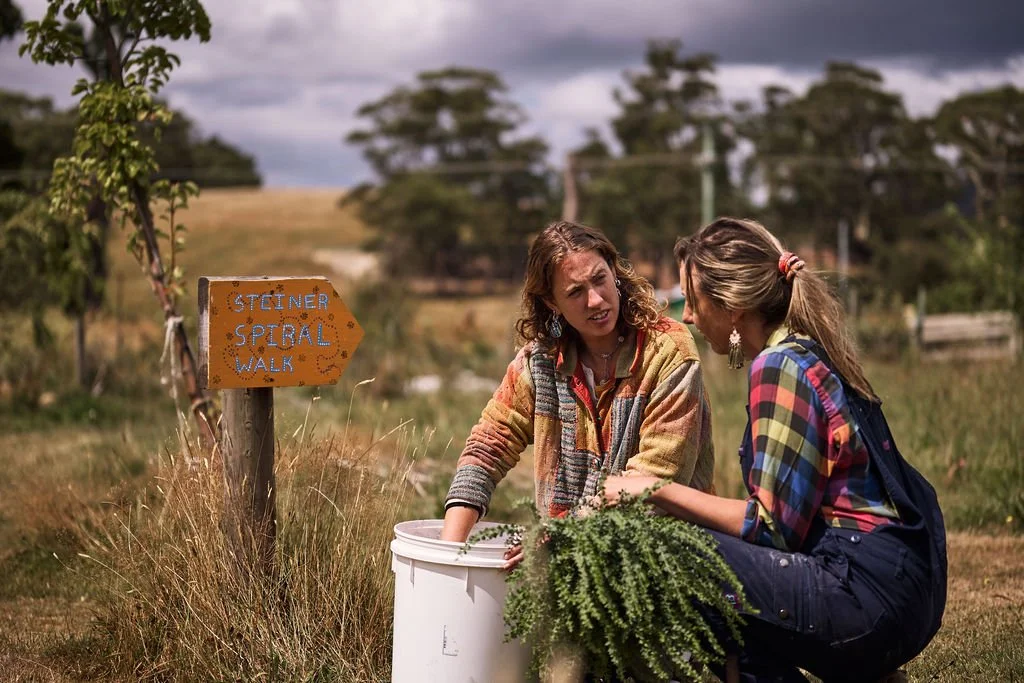
Photography by Ness Vanderburgh at Magical Farm Tasmania
Designing Life Now
This is one of the central impulses of Con Viv Design Studio, to create forms, frameworks and strategies that help people and communities move from fragmentation toward living coherence. It is about more than systems thinking in the abstract. It is about designing with life, recognising that the material, cultural and spiritual dimensions of existence are not separate silos but interdependent layers of one living whole. It is about asking how farms become places of learning, how policy becomes an instrument of nourishment and participation, how councils might relate more intelligently to local capability, how education can support practical citizenship, and how regional economies can circulate value rather than merely extract it.
So a Florentine basilica is not only a relic of renaissance symbolism. It is a reminder that civilisation is healthiest when hands, head and heart remain in conversation, when farming is honoured, when knowledge deepens perception, when governance is guided by justice and meaning, and when food systems are understood not as supply chains alone but as living cultural infrastructures. The wall becomes contemporary the moment we allow it to challenge us.
The task before us is not to admire history from a distance, but to receive its insight as a design brief. If philosophy does not enter policy, if history does not inform pedagogy, if symbolic knowledge does not shape institutions, then we have learned very little. But if we allow those older gestures toward wholeness to inform the work of Grow Small Feed All, the educational pathways of Living Earth College, the practical invitation of Activating Food Systems, and the wider social imagination of Con Viv, then the old wall begins to speak again in present tense.
A living culture must nourish material life, cultivate understanding and remain answerable to meaning. That, perhaps, is the real lesson held in stone. And that is also the work before us now, in Tasmania and beyond, to design forms of life in which soil, soul and society may once again live in right relationship.
Photography by Ness Vanderburgh